MCQ
Consider the situation of the previous problem. Let the water push the left wall by a force $F_1$ and the right wall by a force $F_2,$
  • A
    $\mathrm{F}_1=\mathrm{F}_2$
  • $\mathrm{~F}_1>\mathrm{F}_2$
  • C
    $\mathrm{~F}_1<\mathrm{F}_2$
  • D
    The information is insufficient to know the relation between $F_1$ and $F_2$
Answer

Correct option: B.
$\mathrm{~F}_1>\mathrm{F}_2$
When the box is accelerated towards right, the water in the box experiences a pseudo force $(ma)$ towards left, where m is the mass of water.
So, the force $F_1$ exerted by the water on the the left wall of the box is greater.

Need a full question paper?

Generate a complete, print-ready paper with questions like this in minutes — across 16+ boards, with answer keys.

Start Generating Free

Similar questions

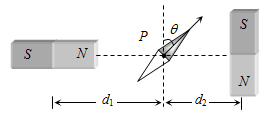
Two magnets A and B are identical and these are arranged as shown in the figure. Their length is negligible in comparison to the separation between them. A magnetic needle is placed between the magnets at point P which gets deflected through an angle θ under the influence of magnets. The ratio of distance $d_1$ and $d_2$ will be
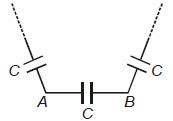
On each side of a polygon of $n$ sides a capacitor of capacitance $C$ is placed as shown in figure. Equivalent capacitance across $A$ and $B$ is
Assertion : The induced e.m.f. and current will be same in two identical loops of copper and aluminium, when rotated with same speed in the same magnetic field.
Reason : Induced e.m.f. is proportional to rate of change of magnetic field while induced current depends on resistance of wire.
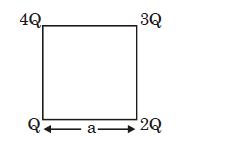
Electrostatic potential energy of given system will be
An ammeter with internal resistance 90 Ω reads 1.85 A when connected in a circuit containing a battery and two resistors 700 Ω and 410 Ω in series. Actual current will be
Which of the following is diamagnetism
The frequency of revolution of a charged particle in a cyclotron does not depend on $‘X\ ’$. Identify $X.$
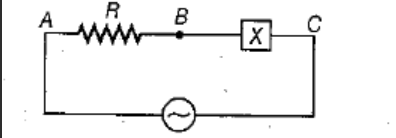
In the given circuit $R$ in pure resistance and $X$ is unknown circuit element. $A n A C$ voltage source is applied across $A$ and $C$. If $V_{A B}=V_{A C}$, then $X$ is.
Image
For a cell of e.m.f. 2V, a balance is obtained for 50 cm of the potentiometer wire. If the cell is shunted by a 2Ω resistor and the balance is obtained across 40 cm of the wire, then the internal resistance of the cell is
If the current is doubled, the deflection is also doubled in