Question
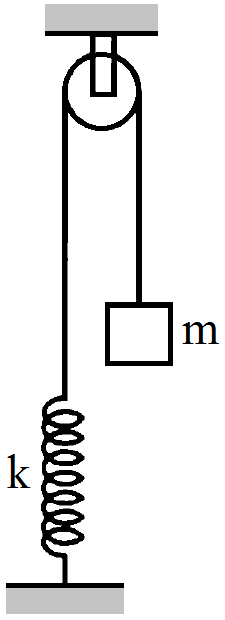
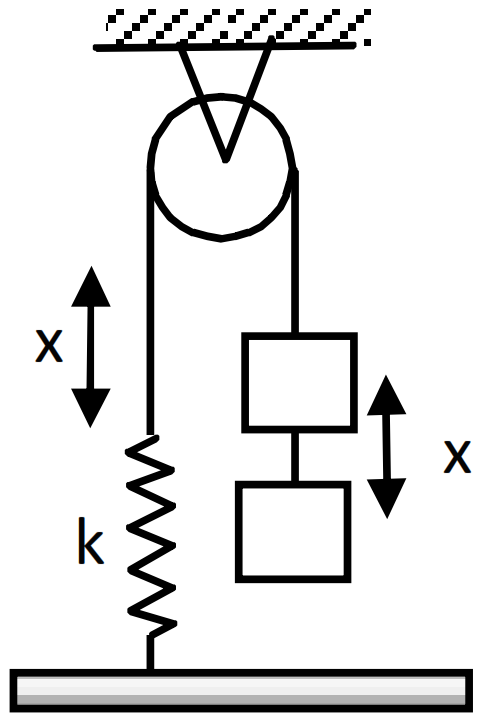
Consider the situation shown in figure. Initially the spring is unstretched when the system is released from rest. Assuming no friction in the pulley, find the maximum elongation of the spring.
Answer

Mass of the body = m

Let the elongation be x

So, $\frac{1}{2}\text{kx}^2=\text{mgx}$

$\Rightarrow\text{x}=2\text{mg}/\text{k}$
Need a full question paper?

Generate a complete, print-ready paper with questions like this in minutes — across 16+ boards, with answer keys.
Start Generating Free

Similar questions

Current is allowed to flow in a metallic wire at a constant potential difference. When the wire becomes hot, cold water is poured on half of its portion. By doing so, its other half portion becomes still more hot. Explain its reason.
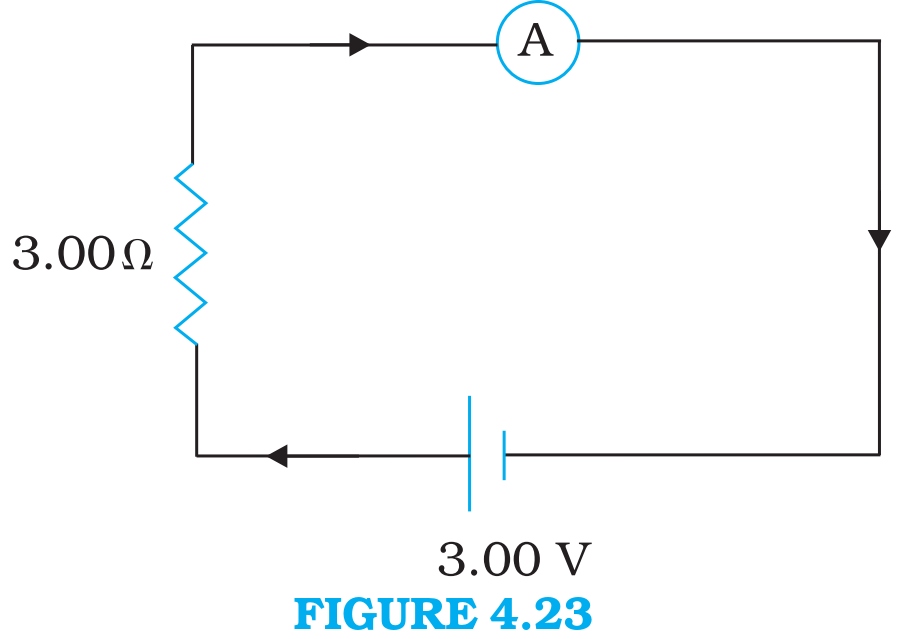
In the circuit (Fig. 4.23) the current is to be measured. What is the value of the current if the ammeter shown (a) is a galvanometer with a resistance $R_G=60.00 \Omega$; (b) is a galvanometer described in (a) but converted to an ammeter by a shunt resistance $r_s=0.02 \Omega$; (c) is an ideal ammeter with zero resistance?
Image
Answer the following questions: The angle subtended at the eye by an object is equal to the angle subtended at the eye by the virtual imae produced by a magnifying glass. In what sense then does a magnifying glass provide angular magnification?
What is electric current ? Explain about it.
Assume that the magnetic field is uniform in a cubical region and is zero outside. Can you project a charged particle from outside into the field so that the particle describes a complete circle in the field?
An electroplating unit plates 3.0g of silver on a brass plate in 3.0 minutes. Find the current used by the unit. The electrochemical equivalent of silver is 1.12 × 10-6 kg C-1.
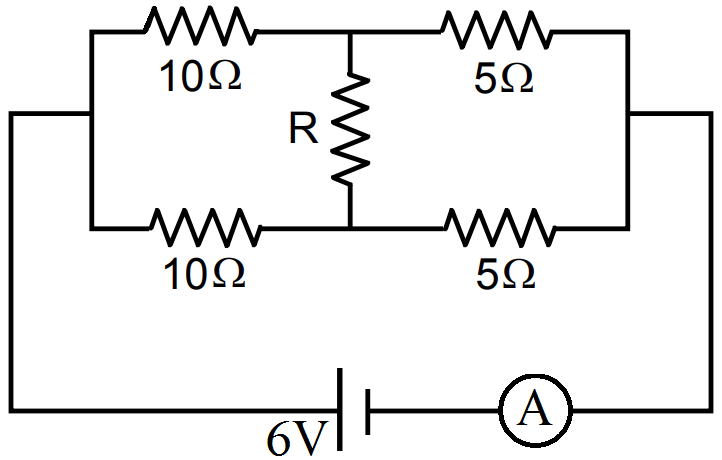
What should be the value of R in the figure. for which the current in it is zero?

Describe schematically the equipotential surfaces corresponding to:
  1. a constant electric field in the z-direction.
  2. a field that uniformly increases in magnitude but remains in a constant (say, z) direction.
  3. a single positive charge at the origin, and.
  4. a uniform grid consisting of long equally spaced parallel charged wires in a plane.
X and Y are two parallel plate capacitors, whose plates have the same area and the same distance between them. There is air between the plates of $X$ and a dielectric material of dielectric constant $k=5$ between the plates of $Y$ (in the figure). (a) Calculate the potential diffe-rence between the plates X and Y . (b) What is the ratio of electrical potential energies stored in X and Y ?
Can a plane mirror ever form a real image?