MCQ
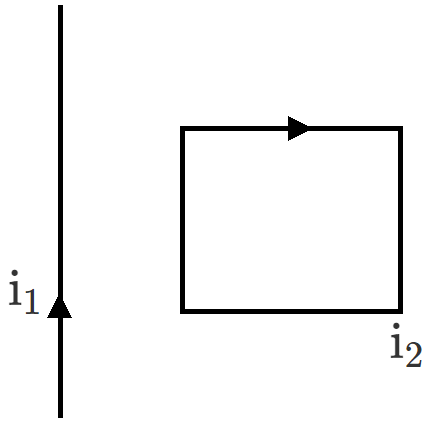
Consider the situation shown in figure. The straight wire is fixed but the loop can move under magnetic force. The loop will:
- ARemain stationary.
- BMove towards the wire.
- CMove away from the wire.
- DRotate about the wire.
Explanation:
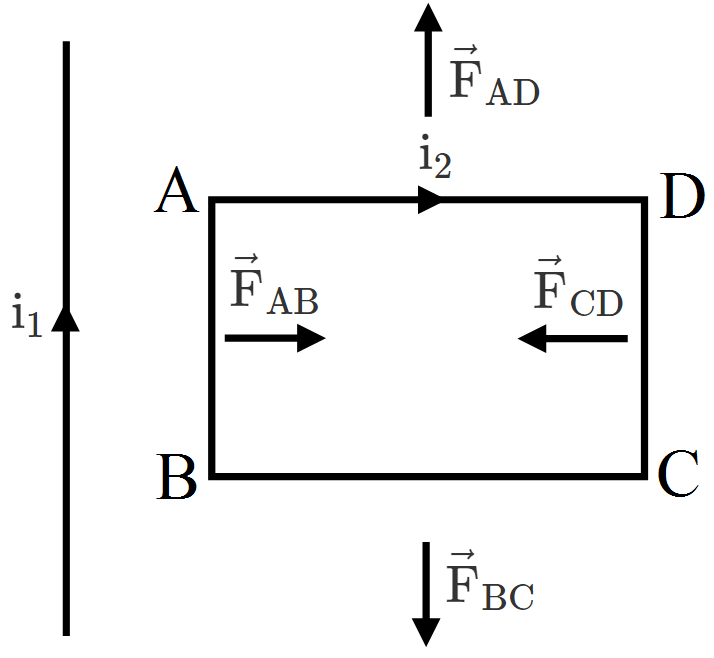
$\overrightarrow{\text{F}}_\text{AD}+\overrightarrow{\text{F}}_\text{BC}=0$
$\overrightarrow{\text{F}}_\text{AB}>\overrightarrow{\text{F}}_\text{CD}$
Force acting on the wire per unit length carrying current i2 due to the wire carrying current i1 placed at a distance d is given by,
$\text{F}=\frac{\mu_0\text{i}_1\text{i}_2}{2\pi\text{d}}$
So, forces per unit length acting on sides AB and CD are as follows:
$\text{F}_\text{AB}=\frac{\mu_0\text{i}_1\text{i}_2}{2\pi\text{d}}$ (Towards the wire)
$\text{F}_\text{CD}=\frac{\mu_0\text{i}_1\text{i}_2}{2\pi(\text{d}+\text{a})}$ (Away from the wire)
Here, FAB > FCD because force is inversly proportional to the distance from the wire and wire AB is closer to the wire carrying current i1.
The forces per unit length acting on sides BC and DA will be equal and opposite, as they are equally away from the wire carrying current i1, with current i2 flowing in the opposite direction.
$\therefore\text{F}_\text{BC}=-\text{F}_\text{DA}$
Now,
Net force:
$\text{F} = \text{F}_\text{AB}+\text{F}_\text{BC}+\text{F}_\text{CD}+\text{F}_\text{DA}$
$\Rightarrow\text{F}=\frac{\mu_0\text{i}_1\text{i}_2}{2\pi\text{d}}+\text{F}_\text{BC}-\frac{\mu_0\text{i}_1\text{i}_2}{2\pi(\text{d+a})}-\text{F}_\text{BC}$
$\Rightarrow\text{F}=\frac{\mu_0\text{i}_1\text{i}_2}{2\pi}\Big(\frac{1}{\text{d}}-\frac{1}{\text{d+a}}\Big)$
$\Rightarrow\text{F}=\frac{\mu_0\text{i}_1\text{i}_2\text{a}}{2\pi\text{d}(\text{d+a})}$
(Towards the wire)
Therefore, the loop will move towards the wire.
Generate a complete, print-ready paper with questions like this in minutes — across 16+ boards, with answer keys.
Huygen’s principle of secondary wavelets may be used to
|
(a) Find the velocity of light in vacuum |
|
(b) Explain the particle behaviour of light |
|
(c) Find the new position of the wavefront |
|
(d) Explain photoelectric effect |
The wavelength of yellow line of sodium is 5896 Å. Its wave number will be
|
(a) 50883 × 1010 per second |
(b) 16961 per cm |
|
(c) 17581 per cm |
(d) 50883 per cm |
When air is replaced by a dielectric medium of constant k, the maximum force of attraction between two charges separated by a distance
|
(a) Decreases k times |
(b) Remains unchanged |
|
(c) Increases k times |
(d) Increases |
