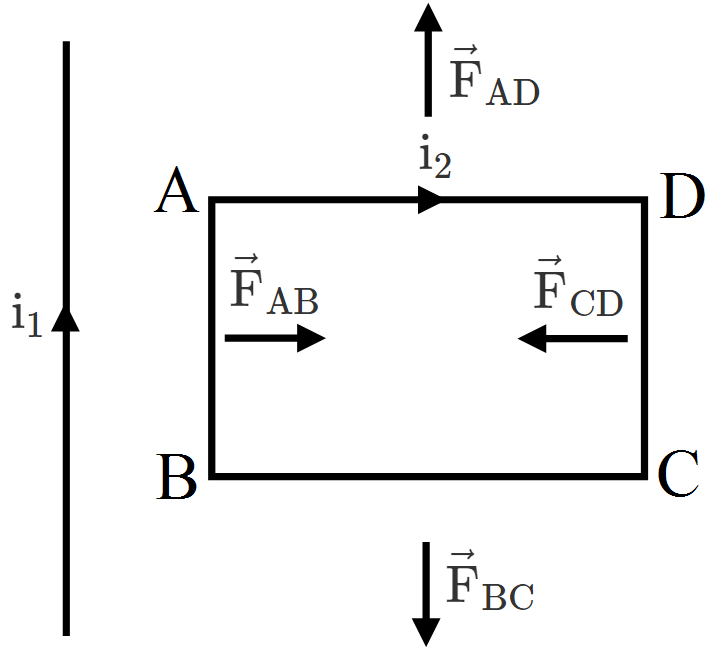
- Remain stationary.
- Move towards the wire.
- Move away from the wire.
- Rotate about the wire.

Explanation:

$\overrightarrow{\text{F}}_\text{AD}+\overrightarrow{\text{F}}_\text{BC}=0$
$\overrightarrow{\text{F}}_\text{AB}>\overrightarrow{\text{F}}_\text{CD}$
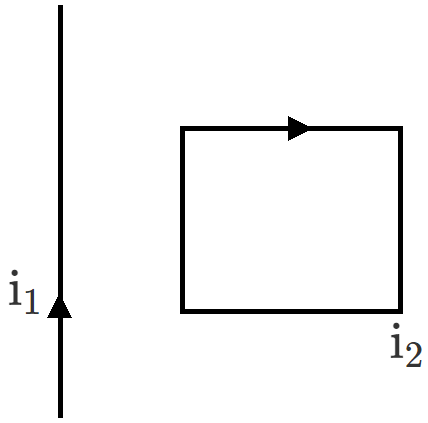
Force acting on the wire per unit length carrying current i2 due to the wire carrying current i1 placed at a distance d is given by,
$\text{F}=\frac{\mu_0\text{i}_1\text{i}_2}{2\pi\text{d}}$
So, forces per unit length acting on sides AB and CD are as follows:
$\text{F}_\text{AB}=\frac{\mu_0\text{i}_1\text{i}_2}{2\pi\text{d}}$ (Towards the wire)
$\text{F}_\text{CD}=\frac{\mu_0\text{i}_1\text{i}_2}{2\pi(\text{d}+\text{a})}$ (Away from the wire)
Here, FAB > FCD because force is inversly proportional to the distance from the wire and wire AB is closer to the wire carrying current i1.
The forces per unit length acting on sides BC and DA will be equal and opposite, as they are equally away from the wire carrying current i1, with current i2 flowing in the opposite direction.
$\therefore\text{F}_\text{BC}=-\text{F}_\text{DA}$
Now,
Net force:
$\text{F} = \text{F}_\text{AB}+\text{F}_\text{BC}+\text{F}_\text{CD}+\text{F}_\text{DA}$
$\Rightarrow\text{F}=\frac{\mu_0\text{i}_1\text{i}_2}{2\pi\text{d}}+\text{F}_\text{BC}-\frac{\mu_0\text{i}_1\text{i}_2}{2\pi(\text{d+a})}-\text{F}_\text{BC}$
$\Rightarrow\text{F}=\frac{\mu_0\text{i}_1\text{i}_2}{2\pi}\Big(\frac{1}{\text{d}}-\frac{1}{\text{d+a}}\Big)$
$\Rightarrow\text{F}=\frac{\mu_0\text{i}_1\text{i}_2\text{a}}{2\pi\text{d}(\text{d+a})}$
(Towards the wire)
Therefore, the loop will move towards the wire.
Generate a complete, print-ready paper with questions like this in minutes — across 16+ boards, with answer keys.
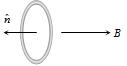
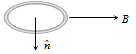
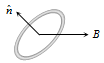
A current carrying loop is placed in a uniform magnetic field in four different orientations, I,II, III & IV arrange them in the decreasing order of potential Energy
(a)
(b)
(c)
(d) 
|
(a) I > III > II > IV |
(b) I > II >III > IV |
(c) I > IV > II > III |
(d) III > IV > I > II |
A particle is moving in a uniform magnetic field, then
|
(a) Its momentum changes but total energy remains the same |
|
(b) Both momentum and total energy remain the same |
|
(c) Both will change |
|
(d) Total energy changes but momentum remains the same |
In a PN-junction diode
|
(a) The current in the reverse biased condition is generally very small |
|
(b) The current in the reverse biased condition is small but the forward biased current is independent of the bias voltage |
|
(c) The reverse biased current is strongly dependent on the applied bias voltage |
|
(d) The forward biased current is very small in comparison to reverse biased current |
Assertion : A P-N photodiode is made from a semiconductor for which Eg = 2.8 eV. This photo diode will not detect the wavelength of 6000 nm.
Reason : A PN photodiode detect wavelength l if .
|
(a) If both assertion and reason are true and the reason is the correct explanation of the assertion. |
|
(b) If both assertion and reason are true but reason is not the correct explanation of the assertion. |
|
(c) If assertion is true but reason is false. |
|
(d) If the assertion and reason both are false. |
The magnetic induction in air at a distance d from an isolated point pole of strength m unit will be
|
(a) |
(b) |
(c) md |
(d) |