MCQ
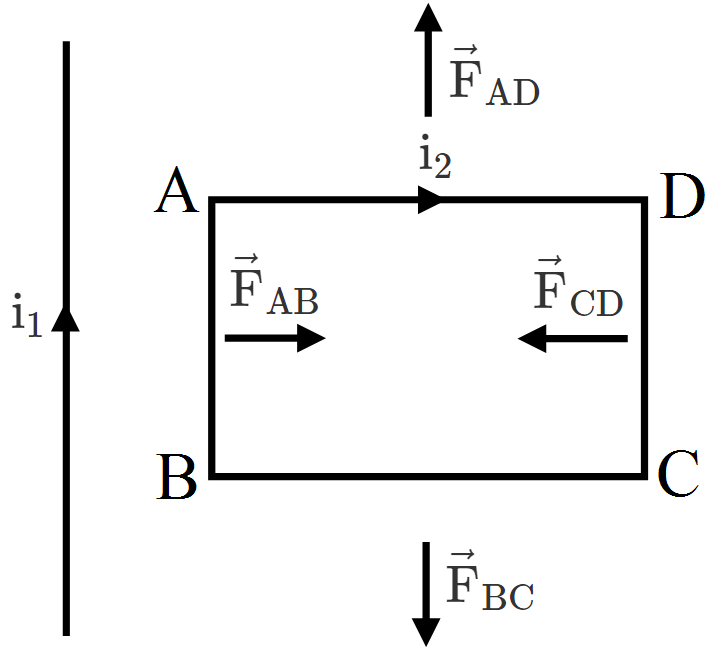
Consider the situation shown in figure. The straight wire is fixed but the loop can move under magnetic force. The loop will:
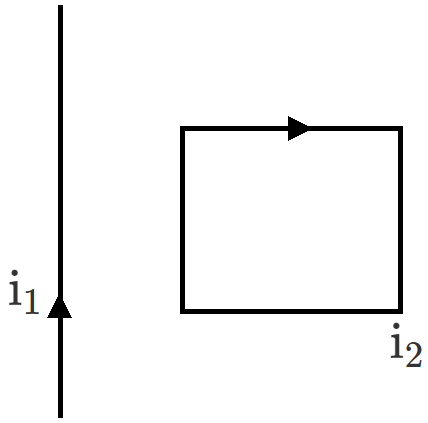
  • A
    Remain stationary.
  • Move towards the wire.
  • C
    Move away from the wire.
  • D
    Rotate about the wire.

Answer

Correct option: B.
Move towards the wire.

$\overrightarrow{\text{F}}_\text{AD}+\overrightarrow{\text{F}}_\text{BC}=0$
$\overrightarrow{\text{F}}_\text{AB}>\overrightarrow{\text{F}}_\text{CD}$
Force acting on the wire per unit length carrying current $i_2$ due to the wire carrying current $i_1$ placed at a distance $d$ is given by,
$\text{F}=\frac{\mu_0\text{i}_1\text{i}_2}{2\pi\text{d}}$
So, forces per unit length acting on sides $AB$ and $CD$ are as follows:
$\text{F}_\text{AB}=\frac{\mu_0\text{i}_1\text{i}_2}{2\pi\text{d}} ($Towards the wire$)$
$\text{F}_\text{CD}=\frac{\mu_0\text{i}_1\text{i}_2}{2\pi(\text{d}+\text{a})} ($Away from the wire$)$
Here, $F_{AB} > F_{CD}$ because force is inversly proportional to the distance from the wire and wire $AB$ is closer to the wire carrying current $i_1$.
The forces per unit length acting on sides $BC$ and $DA$ will be equal and opposite, as they are equally away from the wire carrying current $i_1$, with current $i_2$ flowing in the opposite direction.
$\therefore\text{F}_\text{BC}=-\text{F}_\text{DA}$
Now,
Net force:
$\text{F} = \text{F}_\text{AB}+\text{F}_\text{BC}+\text{F}_\text{CD}+\text{F}_\text{DA}$
$\Rightarrow\text{F}=\frac{\mu_0\text{i}_1\text{i}_2}{2\pi\text{d}}+\text{F}_\text{BC}-\frac{\mu_0\text{i}_1\text{i}_2}{2\pi(\text{d+a})}-\text{F}_\text{BC}$
$\Rightarrow\text{F}=\frac{\mu_0\text{i}_1\text{i}_2}{2\pi}\Big(\frac{1}{\text{d}}-\frac{1}{\text{d+a}}\Big)$
$\Rightarrow\text{F}=\frac{\mu_0\text{i}_1\text{i}_2\text{a}}{2\pi\text{d}(\text{d+a})}$
$($Towards the wire$)$
Therefore, the loop will move towards the wire.

Need a full question paper?

Generate a complete, print-ready paper with questions like this in minutes — across 16+ boards, with answer keys.
Start Generating Free

Similar questions

If yellow light emitted by sodium lamp in Young's double slit experiment is replaced by monochromatic blue light of the same intensity
Choose the correct statement for amplitude modulation
The de Broglie wavelength of a proton and $\alpha$ -particle are equal. The ratio of their velocities is ...... .
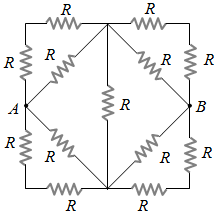
Thirteen resistances each of resistance R ohm are connected in the circuit as shown in the figure below. The effective resistance between A and B is
 
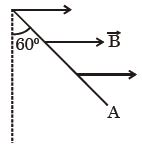
Find .......$Wb/m^2$ the magnetic flux density, if a flux of $2 \times 10^{-3}$ $weber$ passes through the slant area $A = 10\, cm^2$
Two radioactive elements $R$ and $S$ disintegrate as
$R \rightarrow P + \alpha; \lambda_R = 4.5 × 10^{-3} \,\, years^{-1}$
$S \rightarrow P + \beta; \lambda_S = 3 × 10^{-3} \,\, years^{-1}$
Starting with number of atoms of $R$ and $S$ in the ratio of $2 : 1,$ this ratio after the lapse of three half lives of $R$ will be :
The period of oscillations of a magnet is 2 sec. When it is remagnetised so that the pole strength is 4 times its period will be
In a certain region of space, variation of potential with distance from origin as we move along $x$-axis is given by $V=8 x^2+2$, where $x$ is the $x$-coordinate of a point in space. The magnitude of electric field at a point $(-4,0)$ is .......... $V / m$
In a Young's double slit experiment, the angular width of fringe formed on a distant screen is $0.1$ $radian$ . Find the distance between the two slits, if wavelength of light used is $6000\,\mathop A\limits^o $....$\mu m$
The focal length of lens of refractive index $1.5$ in air is $0.30 m.$ When it is immersed in a liquid of refractive index $\frac{4}{3}$, then its focal length in liquid will be......$cm$