MCQ
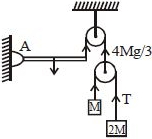
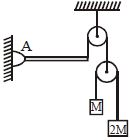
Consider the situation shown in the figure. Uniform rod of length $L$ can rotate freely about the hinge $A$ in vertical plane. Pulleys and string are light and frictionless. If therod remains horizontal at rest when the system is released then the mass of the rod is :
  • A
    $\frac{4}{3} M$
  • B
    $\frac{8}{3} M$
  • $\frac{16}{3} M$
  • D
    $\frac{32}{3} M$

Answer

Correct option: C.
$\frac{16}{3} M$
c
$\mathrm{T}=\frac{2 \mathrm{M}_{1} \mathrm{M}_{2} \mathrm{g}}{\mathrm{M}_{1}+\mathrm{M}_{2}}$

$\mathrm{T}=\frac{2 \mathrm{Mg}}{3}$

Balancing torque

$\mathrm{M}_{\mathrm{g}} \times \frac{\mathrm{L}}{2}=\frac{4 \mathrm{Mg}}{3} \times \mathrm{L}$

$\frac{M^{\prime}}{2}=\frac{4 M}{3}$

$M^{\prime}=\frac{8 M}{3}$

Need a full question paper?

Generate a complete, print-ready paper with questions like this in minutes — across 16+ boards, with answer keys.

Start Generating Free

Similar questions

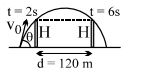
A projectile crosses two walls of equal height $H$ symmetrically as shown The velocity of projection is........ $ms^{-1}$
A copper ball of radius $'r'$ travels with a uniform speed $'v'$ in a viscous fluid. If the ball is changed with another ball of radius $'2r'$ , then new uniform speed will be
In the case of diatomic gas, the heat given at constant pressure is that part of energy which is used for the expansion of gas, is
A mass $m$ attached to free end of a spring executes SHM with a period of $1\; s$. If the mass is increased by $3\; kg$ the period of oscillation increases by one second, the value of mass $m$ is $..............kg$.
A projectile is projected from ground with initial velocity $\vec u\, = \,{u_0}\hat i\, + \,{v_0}\hat j\,$. If acceleration due to gravity $(g)$  is along the negative $y-$ direction then find maximum displacement in $x-$ direction
The Brownian Motion was discovered by the scientist:
The current voltage relation of diode is given by $I=(e^{1000V/T} -1)\;mA$, where the applied voltage $V$ is in volts and the temperature $T$ is in degree Kelvin. If a student makes an error measuring $ \mp 0.01\;V$ while measuring the current of $5\; mA$ at $300\; K$, what will be the error in the value of current in $mA$ ?
Which of the following is self adjusting in nature?
On a frictionless horizontal plane, a bob of mass $m=0.1 kg$ is attached to a spring with natural length $l_0=0.1 m$. The spring constant is $k_1=0.009 Nm ^{-1}$ when the length of the spring $I > l_0$ and is $k_2=0.016 Nm ^{-1}$ when $ I < l_0$. Initially the bob is released from $l=0.15 m$. Assume that Hooke's law remains valid throughout the motion. If the time period of the full oscillation is $T=(n \pi) s$, then the integer closest to $n$ is. . . . .
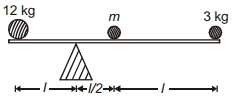
For equilibrium of the system, value of mass $m$ should be .......... $kg$