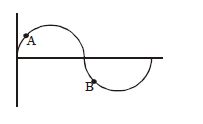
Consider the snapshot of a wave traveling in positive $x$ -direction
Medium
Download our app for free and get started
$\mathrm{V}_{\text {Particle }}=-(\text { slope })\left(\mathrm{v}_{\text {wave }}\right)$
At $A:$ slope $\rightarrow$ $+ve$ so $v_{p}$ is $-ve.$
$O R$
At $\mathrm{B}:$ slope $\rightarrow$ $-ve$ so $\mathrm{v}_{\mathrm{P}}$ is $+ ve.$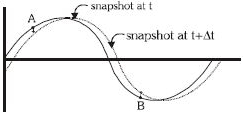

Download our appand get started for free
Experience the future of education. Simply download our apps or reach out to us for more information. Let's shape the future of learning together!No signup needed.*
Similar Questions
- 1A transverse wave is represented by $y= Asin $ $\left( {\omega t - kx} \right)$. For what value of the wavelength is the wave velocity equal to the maximum particle velocity ?View Solution
- 2Two wires are fixed in a sonometer. Their tensions are in the ratio $8 : 1$. The lengths are in the ratio $36:35.$ The diameters are in the ratio $4 : 1$. Densities of the materials are in the ratio $1 : 2$. If the lower frequency in the setting is $360 Hz.$ the beat frequency when the two wires are sounded together isView Solution
- 3A string is stretched between two fixed points separated by $75\,cm$ . It is observed to have resonant frequencies of $420\,Hz$ and $315\,Hz$ . There are no other resonant frequencies between these two. Then, the lowest resonant frequency for this string is ..... $Hz$View Solution
- 4View SolutionIf two waves of same frequency and same amplitude respectively, on superimposition produced a resultant disturbance of the same amplitude, the waves differ in phase by
- 5A transverse wave is passing through a string shown in figure. Mass density of the string is $1 \ kg/m^3$ and cross section area of string is $0.01\ m^2.$ Equation of wave in string is $y = 2sin (20t - 10x).$ The hanging mass is (in $kg$):-View Solution
- 6An observer receives waves directly from a source of sound distant $120\,m$ in a big hall. He also receives waves reflected from the mid-point of $25\,m$ high ceiling. The wavelength of sound for constructive interference to take place between two waves, must be :View Solution
- 7A car $P$ travelling at $20\,ms ^{-1}$ sounds its horn at a frequency of $400\,Hz$. Another car $Q$ is travelling behind the first car in the same direction with a velocity $40\,ms ^{-1}$. The frequency heard by the passenger of the car $Q$ is approximately $.......\,Hz$ [Take, velocity of sound $=360\,ms ^{-1}$ ]View Solution
- 8$Assertion :$ The fundemental frequency of an open organ pipe increases as the temperature is increased.View Solution
$Reason :$ As the temperature increses, the velocity of sound increases more rapidly than length of the pipe. - 9An open pipe of length $33 cm$ resonates with frequency of $100 Hz$. If the speed of sound is $330 m/s$, then this frequency isView Solution
- 10The displacement at a point due to two waves are $y_1=4 \sin (500 \pi t)$ and $y_2=2 \sin (506 \pi t)$. The result due to their superposition will beView Solution