MCQ
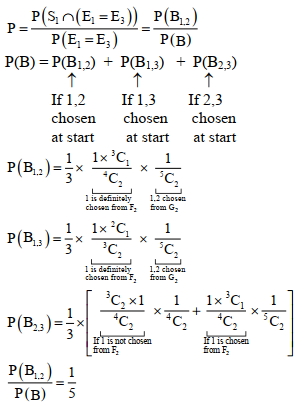
Consider three sets $E_1=\{1,2,3\}, F_1=\{1,3,4\}$ and $G_1=\{2,3,4,5\}$. Two elements are chosen at random, without replacement, from the set $E _1$, and let $S _1$ denote the set of these chosen elements.

Let $E_2=E_1-S_1$ and $F_2=F_1 \cup S_1$. Now two elements are chosen at random, without replacement, from the set $F_2$ and let $S_2$ denote the set of these chosen elements.

Let $G _2= G _1 \cup S _2$. Finally, two elements are chosen at random, without replacement, from the set $G _2$ and let $S _3$ denote the set of these chosen elements.

Let $E_3=E_2 \cup S_3$. Given that $E_1=E_3$, let $p$ be the conditional probability of the event $S_1=\{1,2\}$. Then the value of $p$ is

  • $\frac{1}{5}$
  • B
    $\frac{3}{5}$
  • C
    $\frac{1}{2}$
  • D
    $\frac{2}{5}$

Answer

Correct option: A.
$\frac{1}{5}$
a

Need a full question paper?

Generate a complete, print-ready paper with questions like this in minutes — across 16+ boards, with answer keys.

Start Generating Free

Similar questions

A binary number is made up of $16$ bits. The probability of an incorrect bit appearing is $p$ and the errors in different bits are independent of one another. The probability of forming an incorrect number is
Let  ,  $f(x) = \min \left\{ {{{\sin }^{ - 1}}x,{{\cos }^{ - 1}}x} \right\}$ then area bounded by $f(x)$ and $x-$ axis is
Let $f: R \rightarrow R$ be a function such that $f(x+y)=f(x)+f(y), \quad \forall x, y \in R .$ If $f(x)$ is differentiable at $x=0$, then

$(A)$ $f(x)$ is differentiable only in a finite interval containing zero

$(B)$ $f(x)$ is continuous $\forall x \in R$

$(C)$ $f^{\prime}(x)$ is constant $\forall x \in R$

$(D)$ $f(x)$ is differentiable except at finitely many points

A bag contains $16$ coins of which two are counterfeit with heads on both sides. The rest are fair coins. One coin is selected at random from the bag and tossed. The probability of getting a head is
If $P=\left[\begin{array}{ll}1 & 0 \\ 1 / 2 & 1\end{array}\right]$, then $P^{50}$ is:
Let $\mathrm{n}$ be an odd natural number such that the variance of $1,2,3,4, \ldots, \mathrm{n}$ is $14 .$ Then $\mathrm{n}$ is equal to ..... .
${d \over {dx}}({x^2}{e^x}\sin x) = $
Five numbers are in $A.P.$, whose sum is $25$ and product is $2520 .$ If one of these five numbers is $-\frac{1}{2},$ then the greatest number amongst them is
If all interior angle of quadrilateral are in $A.P.$ If common difference is $10^o$, then find smallest angle ? .............. $^o$
A normal chord of the parabola $ y^2 = 4x$  subtending a right angle at the vertex makes an acute angle $ \theta $ with the $x-$ axis, then $\theta$  equals to