MCQ
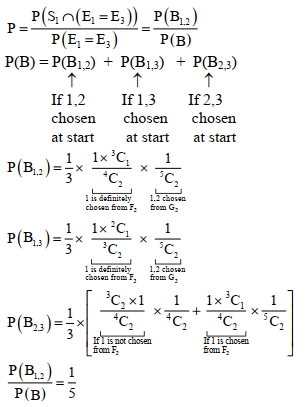
Consider three sets $E_1=\{1,2,3\}, F_1=\{1,3,4\}$ and $G_1=\{2,3,4,5\}$. Two elements are chosen at random, without replacement, from the set $E _1$, and let $S _1$ denote the set of these chosen elements.

Let $E_2=E_1-S_1$ and $F_2=F_1 \cup S_1$. Now two elements are chosen at random, without replacement, from the set $F_2$ and let $S_2$ denote the set of these chosen elements.

Let $G _2= G _1 \cup S _2$. Finally, two elements are chosen at random, without replacement, from the set $G _2$ and let $S _3$ denote the set of these chosen elements.

Let $E_3=E_2 \cup S_3$. Given that $E_1=E_3$, let $p$ be the conditional probability of the event $S_1=\{1,2\}$. Then the value of $p$ is

  • $\frac{1}{5}$
  • B
    $\frac{3}{5}$
  • C
    $\frac{1}{2}$
  • D
    $\frac{2}{5}$

Answer

Correct option: A.
$\frac{1}{5}$
a

Need a full question paper?

Generate a complete, print-ready paper with questions like this in minutes — across 16+ boards, with answer keys.

Start Generating Free

Similar questions

The equation of the normal at the point $\left( {\frac{a}{4},\;a} \right)$ to the parabola ${y^2} = 4ax$, is
Equation of line perpendicular to straight line $3 x-4 y$ $+7=0$ and passing through point $(1,-2)$ is given by :
The  the circle passing through the foci of the $\frac{{{x^2}}}{{16}} + \frac{{{y^2}}}{9} = 1$ and having centre at $(0,3) $ is
Let $z$ be a complex number such that $\left|\frac{z-2 i}{z+i}\right|=2, z \neq-i$. Then $z$ lies on the circle of radius $2$ and centre
For all positive integral values ofn, $3^{2n} - 2n + 1$ is divisible by:
A straight line through the vertex $P$ of a triangle $P Q R$ intersects the side $Q R$ at the point $S$ and the circumcircle of the triangle $P Q R$ at the point $T$. If $S$ is not the centre of the circumcircle, then

$(A)$ $\frac{1}{\mathrm{PS}}+\frac{1}{\mathrm{ST}}<\frac{2}{\sqrt{\mathrm{QS} \times \mathrm{SR}}}$

$(B)$ $\frac{1}{\mathrm{PS}}+\frac{1}{\mathrm{ST}}>\frac{2}{\sqrt{\mathrm{QS} \times \mathrm{SR}}}$

$(C)$ $\frac{1}{\mathrm{PS}}+\frac{1}{\mathrm{ST}}<\frac{4}{\mathrm{QR}}$

$(D)$ $\frac{1}{\mathrm{PS}}+\frac{1}{\mathrm{ST}}>\frac{4}{\mathrm{QR}}$

In how many ways can five examination papers be arranged so that physics and chemistry papers never come together
If $a, b, c, d$ and $p$ are distinct real numbers such that $(a^2 + b^2 + c^2)\,p^2 -2p\, (ab + bc + cd) + (b^2 + c^2 + d^2)  \le 0$, then
If $\text{f(x)}=\sin[\pi^2]\text{x}+\sin[-\pi^2]\text{x},$ where [x] denotes the greatest integer less than or equal to x, then: