MCQ
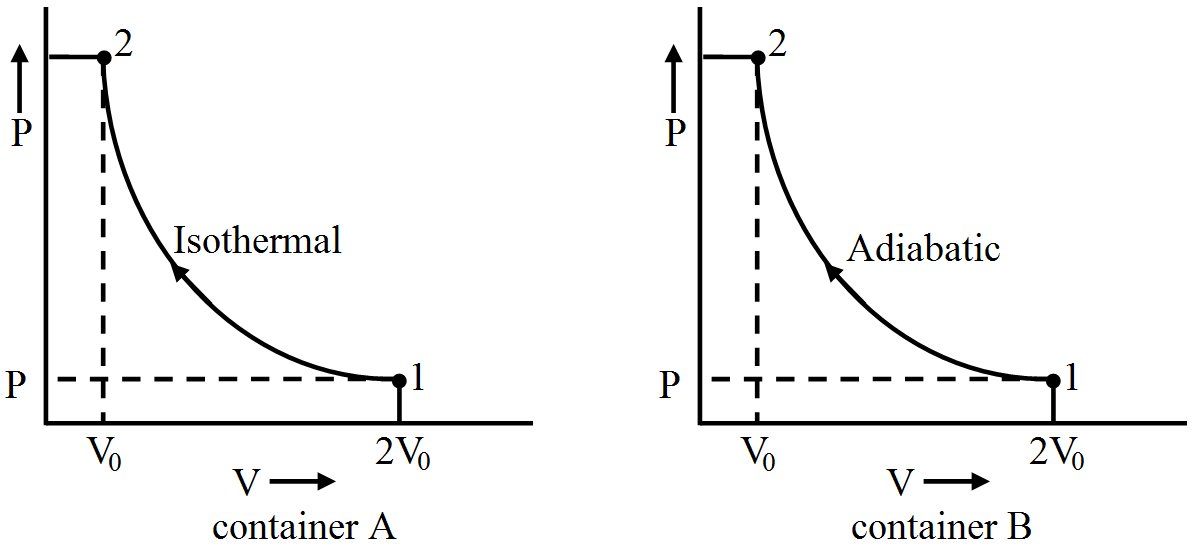
Consider two containers A and B containing identical gases at the same pressure, volume and temperature. The gas in container A is compressed to half of its original volume isothermally while the gas in container B is compressed to half of its original value adiabatically. The ratio of final pressure of gas in B to that of gas in A is
  • $2^{\gamma-1}$
  • B
    $\Big(\frac{1}{2}\Big)^{\gamma-1}$
  • C
    $\Big(\frac{1}{1-\gamma}\Big)^2$
  • D
    $\Big(\frac{1}{\gamma-1}\Big)^2$

Answer

Correct option: A.
$2^{\gamma-1}$
According to the P-V diagram shown for the container A (which is going through isothermal process) and for container B (which is going through adiabatic process).

Both the process involves compression of the gas.
(I) Isothermal compression (gas A) (during 1 → 2)
$\text{P}_{1}\text{V}_{1}=\text{P}_{2}\text{V}_{2}$
$\Rightarrow\text{P}_{0}(2\text{V}_{0})^\gamma=\text{P}_{2}(\text{V}_{0})^\gamma$
$\Rightarrow\text{P}_{0}(2\text{V}_{0})=\text{P}_{2}(\text{V}_{0})$
(ii) Adiabatic compression, (gas B) (during 1 → 2)
$\text{P}_{1}\text{V}_{1} ^\gamma=\text{P}_{2}\text{V}_{2}^\gamma$
$\text{P}_{0}(2\text{V}_{0})^\gamma=\text{P}_{2}(\text{V}_{0})^\gamma$
$\text{P}_{2}=\Big(\frac{2\text{V}_{0}}{\text{V}_{0}}\Big)^\gamma\text{P}_{0}=(2)^\gamma\text{P}_{0}$
Hence $\frac{(\text{P}_{2})_\text{B}}{(\text{P}_{2})_\text{A}}=$ Ratio of final pressure $=\frac{(2)^\gamma\text{P}_{0}}{2\text{P}_{0}}=2^{\gamma-1}$
where, $\gamma$ is ratio of specific heat capacities for the gas.

Need a full question paper?

Generate a complete, print-ready paper with questions like this in minutes — across 16+ boards, with answer keys.

Start Generating Free

Similar questions

A body of mass $1\, kg$ is under a force, which causes a displacement in it is given by $x = \frac{{{t^3}}}{3}$ (in $m$). Find the work done by the force in first second ............ $\mathrm{J}$
A stone of mass $0.25\; kg$ tied to the end of a string is whirled round in a circle of radius $1.5 \;m$ with a speed of $40\; rev./min$ in a hortzontal plane. What is the tenston in the string? What is the maximum speed in $m/s $ with which the stone can be whirled around if the string can withstand a maximum tension of $200\; N ?$
While measuring the acceleration due to gravity by a simple pendulum, a student makes a positive error of $1\%$ in the length of the pendulum and a negative error of $3\%$ in the value of time period. His percentage error in the measurement of $g$ by the relation $g = 4{\pi ^2}\left( {l/{T^2}} \right)$ will be  ........ $\%$
The workdone by a gas molecule in an isolated system is given by, $W =\alpha \beta^{2} e ^{-\frac{ x ^{2}}{\alpha kT }},$ where $x$ is the displacement, $k$ is the Boltzmann constant and $T$ is the temperature, $\alpha$ and $\beta$ are constants. Then the dimension of $\beta$ will be
Three particles each of mass $m$ are kept at vertices of an equilateral triangle of side $L.$ Th gravitational potential energy possessed by the system is:
A projectile is fired with $KE$ of $1\,kJ$. If the range is maximum, .......... $J$ is its $KE$ at the highest point.
A lead ball moving with a velocity $V$ strikes a wall and stops. If $50\%$ of its energy is converted into heat, then what will be the increase in temperature (Specific heat of lead is $S$)
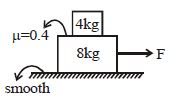
........ $N$  the maximum force for which both the block will move with same acceleration.
Oxygen and hydrogen gases are at same temperature and pressure. And the oxygen molecule has 16 times the mass of hydrogen molecule. Then the ratio of their r.m.s. speed is:
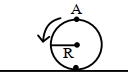
A disc is rolling without slipping on a surface. The radius of the disc is $R$. At $t=0$, the top most point on the disc is $A$ as shown in figure. When the disc completes half of its rotation, the displacement of point $A$ from its initial position is