Question
Consider two different hydrogen atoms. The electron in each atom is in an excited state. Is it possible for the electrons to have different energies but the same orbital angular momentum according to the Bohr model?

Answer

As per Bohr model, $\text{En}=-\Big(\frac{13.6}{\text{n}^2}\Big)$. Now electrons have different energies it means they have different values of n. So, their angular momentum $\Big(\text{mvr}=\frac{\text{nh}}{2\pi}\Big)$ will be different.

Need a full question paper?

Generate a complete, print-ready paper with questions like this in minutes — across 16+ boards, with answer keys.
Start Generating Free

Similar questions

A barometer correctly reads the atmospheric pressure as 76cm of mercury. Water droplets are slowly introduced into the barometer tube by a dropper. The height of the mercury column first decreases and then becomes constant. lf the saturation vapour pressure at the atmospheric temperature is 0.80cm of mercury, find the height of the mercury column when it reaches its minimum value.
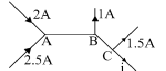
Calculate the value of $i$ as shown in the figure.
Image
Explain conductors and insulators with example. (This question can also be asked as difference between conductors and insulators.)
From the formula of potential energy of a system of two charges, obtain the equation of P.E. of electric dipole in external electric field.
The angular magnification of a system is less than one. Does it mean that the image formed is inverted?
  1. Find the first excitation potential of He+ ion.
  2. Find the ionization potential of Li++ ion.
Write the formula for the torque acting on a current-carrying coil placed in uniform magnetic field and explain its stable and unstable equilibrium states.
State the underlying principle of a transformer.How is the large scale transmission of electric energy over long distances done with the use of transformers?
Electrons are emitted from an electron gun at almost zero velocity and are accelerated by an electric field E through a distance of 1.0m. The electrons are now scattered by an atomic hydrogen sample in ground state. What should be the minimum value of E so that red light of wavelength 656.3nm may be emitted by the hydrogen?
Answer the following question:
In a single slit diffraction experiment, the width of the slit is made double the original width. How does this affect the size and intensity of the central diffraction band?