Question
Consider two elements 'A' (Atomic number 17) and 'B' (Atomic number 19):
  1. Write the positions of these elements in the modern periodic table giving justification.
  2. Write the formula of the compound formed when 'A' combines with 'B.'
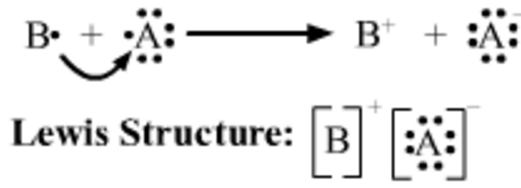
  3. Draw the electron dot structure of the compound and state the nature of the bond formed between the two elements.
Answer

  1. Position of the elements in the periodic table:
Element Period Group
A 3 17
B 4 1
  1.  
Atomic number of A = 17.
Electronic configuration A = 2, 8, 7.
Number of valence electrons of A = 7.
Valency of A = 8 - 7 = 1.
 
Atomic number of B = 19.
Electronic configuration B = 2, 8, 8, 1.
Number of valence electrons of B = 1.
Valency of A = 1.

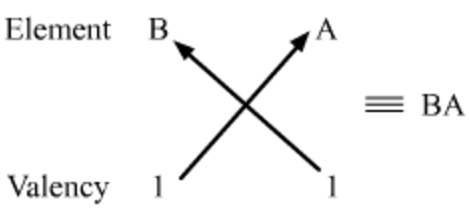
So, the formula of the compound formed when elements A and B combine is BA.
  1.  

Need a full question paper?

Generate a complete, print-ready paper with questions like this in minutes — across 16+ boards, with answer keys.

Start Generating Free

Similar questions

What changes would you suggest in your home in order to be environment-friendly?
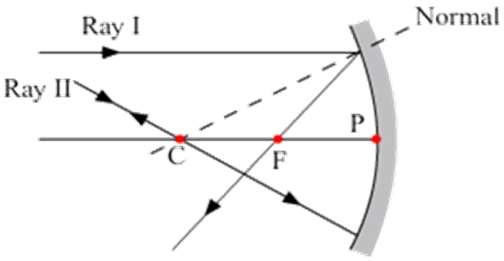
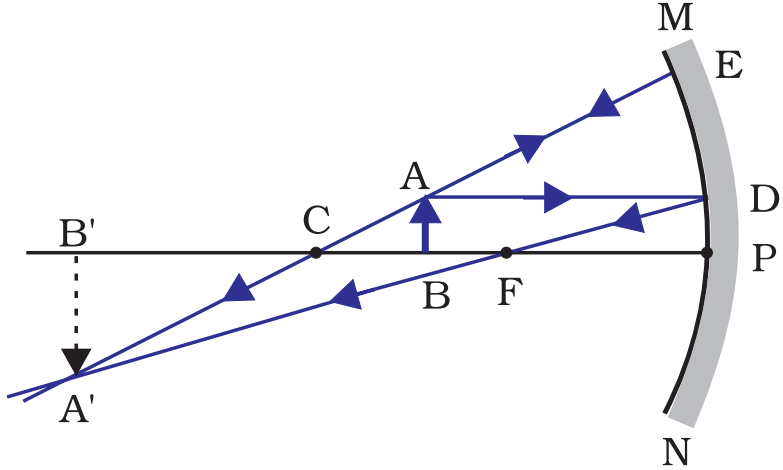
The two rays chosen for the construction of ray diagram is:

Ray 1: When the incident ray is parallel to the principal axis, the reflected ray will pass through the focus of concave mirror or it appears to pass through the focus of convex mirror.
Ray 2: When the incident ray passes through or appears to pass through the centre of curvature, the light, after reflection from the spherical mirror, reflects back along the same path.
The image formed is real, inverted, magnified and is formed beyond the centre of curvature.
  1. Give the names and formulae of one metal chloride and one non-metal chloride.
  2. State an important property in which these metal chloride and non-metal chloride differ.
  3. Why do they differ in this property?
Sudha finds out that the sharp image of the window pane of her science laboratory is formed at a distance of 15cm from the lens. She now tries to focus the building visible to her outside the window instead of the window pane without disturbing the lens. In which direction will she move the screen to obtain a sharp image of the building? What is the approximate focal length of this lens?
What will be the angle of deviation through a prism and $60^{\circ}$, when angles of incidence and emergence are $45^{\circ}$ each?
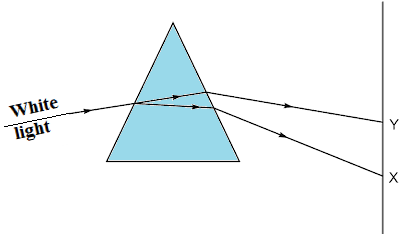
In the figure given alongside, a narrow beam of white light is shown to pass through a triangular glass prism. After passing through the prism, it produces a spectrum YX on the screen:
State the colour seen.
  1. At X, and
  2. At Y​​​​​​​​​​​​

​​​​​​​​​​​​
  1. violet.
  2. Red
  1. ​​​​​​​Why do different colours of white light bend through different angles with respect to the incident beam of light?
With the help of ciliary muscles, the human eye can change its curvature and thus alter the focal length of its lens. State the changes that occur in the curvature and focal length of the eye lens while viewing,
  1. a distance object
  2. nearby objects.
Explain, why a normal eye is not able to see distinctly the objects placed closer than 25 cm, without putting any strain on the eye.
Two ores A and B were taken. On heating ore A gives $CO _2$ whereas, ore B gives $SO _2$. What steps will you take to convert them into metals?
What are the advantages and disadvantages of using a solar cooker?
  1. Give the evidence that the birds have evolved from reptiles.
  2. Insects, octopus, planaria and vertebrates possess eyes. Can we group these animals together on the basis of eyes that they possess? Justify your answer giving reason.