MCQ
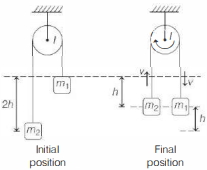
Consider two masses with $m_1 > m_2$ connected by a light inextensible string that passes over a pulley of radius $R$ and moment of inertia $I$ about its axis of rotation. The string does not slip on the pulley and  the pulley turns without friction. The two masses are released from rest separated by a vertical distance $2 h$. When the two masses pass each other, the speed of the masses is proportional to
  • $\sqrt{\frac{m_1-m_2}{m_1+m_2+\frac{I}{R^2}}}$
  • B
    $\sqrt{\frac{\left(m_1+m_2\right)\left(m_1-m_2\right)}{m_1+m_2+\frac{1}{R^2}}}$
  • C
    $\sqrt{\frac{m_1+m_2+\frac{I}{R^2}}{m_1-m_2}}$
  • D
    $\sqrt{\frac{1}{R^2}}$

Answer

Correct option: A.
$\sqrt{\frac{m_1-m_2}{m_1+m_2+\frac{I}{R^2}}}$
a
(a) Loss of potential energy of $m_1$ appears as kinetic energies of $m_1, m_2$ and pulley and also as potential energies of $m_1$ and $m_2$. So, by energy conservation, we get

$m_1 g h=\frac{1}{2} m_1 v^2+\frac{1}{2} m_2 v^2+\frac{1}{2} I \omega^2+m_2 g h$

Here, $m_1$ falls by distance $h, m_2$ rises by distance $h , v=$ speed of $m_1=$ speed of $m_2$ as they passes each other and $\omega=$ angular speed of pulley $=\frac{v}{R}$.

$\text { So, }\left(m_1-m_2\right) g h=\frac{v^2}{2}\left(m_1+m_2+\frac{I}{R^2}\right)$

$\therefore \quad v=\frac{2 g h\left(m_1-m_2\right)}{\left(m_1+m_2+\frac{I}{R^2}\right)}$

$\text { or } \quad v \propto \sqrt{\left(\frac{m_1-m_2}{m_1+m_2}+\frac{I}{R^2}\right)}$

Need a full question paper?

Generate a complete, print-ready paper with questions like this in minutes — across 16+ boards, with answer keys.

Start Generating Free

Similar questions

A particle of mass $m$ moves on a straight line with its velocity increasing with distance according to the equation $\mathrm{v}=\alpha \sqrt{\mathrm{x}}$, where $\alpha$ is a constant. The total work done by all the forces applied on the particle during its displacement from $\mathrm{x}=0$ to $\mathrm{x}=\mathrm{d}$, will be:
A light planet is revolving around a massive star in a circular orbit of radius $R$ with a period of revolution $T$. If the force of attraction between planet and star is proportional to $\mathrm{R}^{-3 / 2}$ then choose the correct option :
Cooking gas containers are kept in a lorry moving with uniform speed. The temperature of the gas molecules inside will
The elastic limit of brass is $379\,MPa.$ .......... $mm$ should be the minimum diameter of a brass rod if it is to support a $400\,N$ load without exceeding its elastic limit .
The ratio of kinetic energies of two spheres rolling with equal centre of mass velocities is $2 : 1$. If their radii are in the ratio $2 : 1$; then the ratio of their masses will be
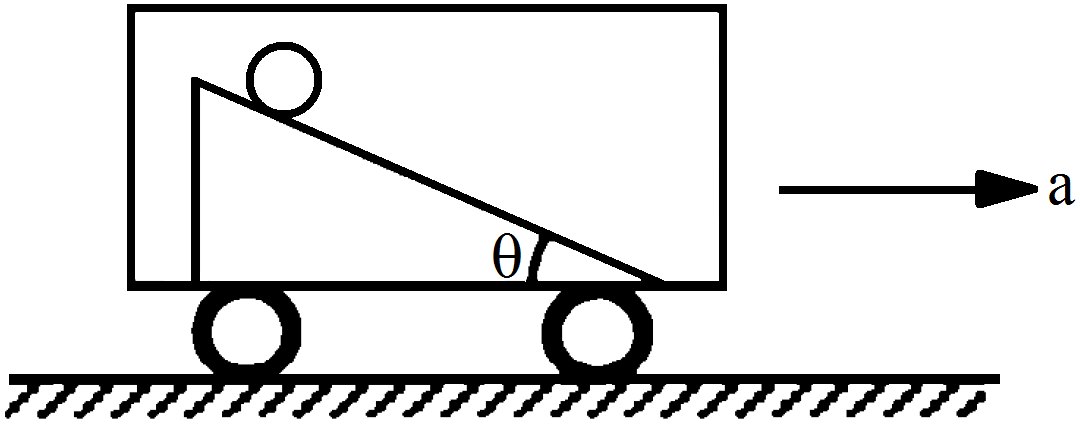
Figure shows a smooth inclined plane fixed in a car accelerating on a horizontal road. The angle of incline 0 is related to the acceleration a of the car as a = g tan°. If the sphere is set in pure rolling on the incline:
If a car at rest accelerates uniformly to a speed of $144\ km/ h$ in $20s$, it covers a distance of:
Two guns $A$ and $B$ can fire bullets at speed $1\, km/s$ and $2\, km/s$ respectively. From a point on a horizontal ground, they are fired in all possible directions. The ratio of maximum areas covered by the bullets fired by the two guns, on the ground is
Hail storms are observed to strike the surface of the frozen lake at $30^o$ with the vertical and rebound at $60^o$ with the vertical. Assume contact to be smooth, the coefficient of restitution is
A quantity $f$ is given by $f=\sqrt{\frac{{hc}^{5}}{{G}}}$ where $c$ is speed of light, $G$ universal gravitational constant and $h$ is the Planck's constant. Dimension of $f$ is that of