Question
Consider two processes on a system as shown in figure.
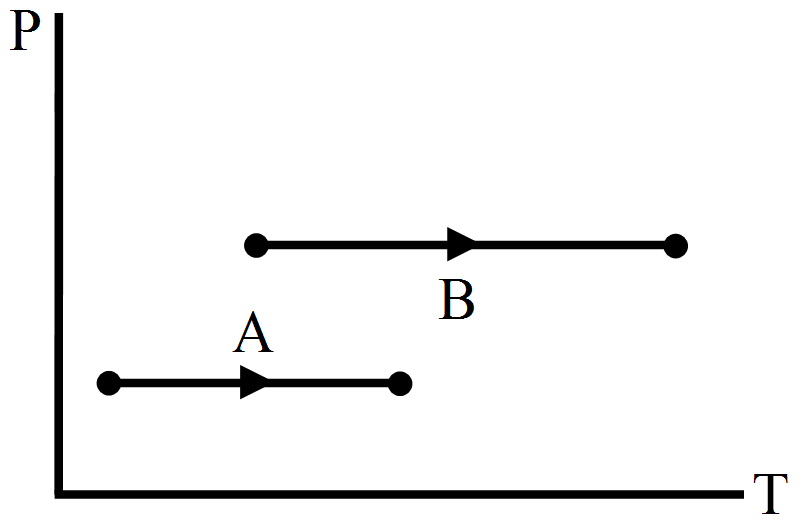
The volumes in the initial states are the same in the two processes and the volumes in the final states are also the same. Let $\Delta\text{W}_1$ and $\Delta\text{W}_2$ be the work done by the system in the processes A and B respectively.

  1. $\Delta\text{W}_1>\Delta\text{W}_2.$

  2. $\Delta\text{W}_1=\Delta\text{W}_2.$

  3. $\Delta\text{W}_1<\Delta\text{W}_2.$

  4. Nothing can be said about the relation between $\Delta\text{W}_1$ and $\Delta\text{W}_2.$
Answer

  1. $\Delta\text{W}_1<\Delta\text{W}_2.$

Explanation:

Work done by the system, $\Delta\text{W}=\text{P}\Delta\text{V}$

Here,

P = Pressure in the process

$\Delta\text{V}$ = Change in volume during the process

Let Vi and Vf​ be the volumes in the initial states and final states for processes A and B, respectively. Then,

$\Delta\text{W}_1=\text{P}_1\Delta\text{V}_1$

$\Delta\text{W}_2=\text{P}_2\Delta\text{V}_2$

But $\Delta\text{V}_2=\Delta\text{V}_1,$ $\big[(\text{V}_{\text{f}_1}-\text{V}_{\text{i}_1})=(\text{V}_{\text{f}_2}-\text{V}_{\text{i}_2})\big]$

$\Rightarrow\frac{\Delta\text{W}_1}{\Delta\text{W}_2}=\frac{\text{P}_1}{\text{P}_2}$

$\Rightarrow\Delta\text{W}_1<\Delta\text{W}_2\ [\because\text{P}_2>\text{P}_1]$

Need a full question paper?

Generate a complete, print-ready paper with questions like this in minutes — across 16+ boards, with answer keys.

Start Generating Free

Similar questions

What is the value of linear velocity if $\overrightarrow r  = 3\widehat i + 4\widehat j + 6\widehat k$ and $\overrightarrow \omega   = -5\widehat i + 3\widehat j + 5\widehat k$ ?
Which of the following are not a unit of time?
A metal block of base area $0.2\; m ^{2}$ is connected to a $0.02\; kg$ mass via a string that passes over an ideal pulley as shown in figure. A liquid film of thickness $0.6\; mm$ is placed between the block and the table. When released the block moves to the right with a constant speed of $0.17\; m / s$. The co-efficient of viscosity of the liquid is
The potential energy between two atoms in a molecule is given by $U(x) = \frac{a}{{{x^{12}}}} - \frac{b}{{{x^6}}}$; where $a$ and $b$ are positive constants and $x$  is the distance between the atoms. The atom is in stable equilibrium when
$Assertion$ : A rocket moves forward by pushing the surrounding air backwards.

$Reason$ : It derives the necessary thrust to move forward according to Newton’s third law of motion

The acceleration of a particle starting from rest, varies with time according to the relation $A = -a\omega^2 sin\omega t.$ The displacement of this particle at a time $t$ will be
Two small drops of mercury, each of radius $R$, coalesce to form a single large drop. The ratio of the total surface energies before and after the change is
A train starting from rest travels the first part of its journey with constant acceleration $a$ , second part with constant velocity $v$ and third part with constant retardation $a$ , being brought to rest. The average speed for the whole journey is $\frac{{7v}}{8}$. The train travels with constant velocity for $...$ of the total time
The coefficient of superficial expansion of a solid is $2 \times 10^{-5} {°C^{-1}}$. It's coefficient of linear expansion is
Which of the following measurements is most precise?