MCQ
Consider two rods of same length and different specific heats $\left( c _1, c _2\right)$, thermal conductivities $\left( K _1, K_2\right)$ and area of cross-sections $\left(A_1, A_2\right)$ and both having temperatures $\left(T_1, T_2\right)$ at their ends. If their rate of loss of heat due to conduction is equal, then:
  • A
    $\frac{K_2 A_1}{c_2}=\frac{K_1 A_2}{c_1}$
  • B
    $K _1 A_1= K _2 A_2$
  • C
    $K _2 A_1= K _1 A_2$
  • D
    $\frac{K_1 A_1}{c_1}=\frac{K_2 A_2}{c_2}$
Need a full question paper?

Generate a complete, print-ready paper with questions like this in minutes — across 16+ boards, with answer keys.

Start Generating Free

Similar questions

The door of a running refrigerator inside a room is left open. The correct statement out of the following ones is:
On doubling the speed of of an object its:
A spaceship of speed $v_0$ travelling along $+ y$ axis suddenly shots out one fourth of its part with speed $2v_0$ along $+ x$ -axis. $xy$ axes are fixed with respect to ground. The velocity of the remaining part is
When a ceiling fan is switched off, its angular velocity falls to half while it makes $36$ $rotations.$ How many more rotations will it make before coming to rest (Assume uniform angular retardation)
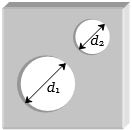
Two holes of unequal diameters $d_1$ and $d_2$ $({d_1} > {d_2})$ are cut in a metal sheet. If the sheet is heated
When an ideal gas is compressed adiabatically, its temperature rises the molecules on the average have more kinetic energy than before. The kinetic energy increases,
To get the maximum flight, a ball must be thrown as
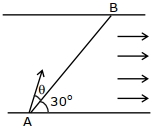
A swimmer wants to cross a river from point $A$ to point $B$. Line $A B$ makes an angle of $30^{\circ}$ with the flow of river. Magnitude of velocity of the swimmer is same as that of the river. The angle $\theta$ with the line ${AB}$ should be $^{\circ}$, so that the swimmer reaches point ${B}$.
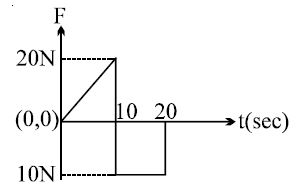
A particle of mass $1\,\, kg$ is acted upon by a force $'F'$ which varies as shown in the figure. If initial velocity of the particle is $10 ms^{^{-1}},$ the maximum velocity attained by the particle during the period is  ........ $ms^{-1}$
The current voltage relation of diode is given by $I=(e^{1000V/T} -1)\;mA$, where the applied voltage $V$ is in volts and the temperature $T$ is in degree Kelvin. If a student makes an error measuring $ \mp 0.01\;V$ while measuring the current of $5\; mA$ at $300\; K$, what will be the error in the value of current in $mA$ ?