Question
Considering the case of a parallel plate capacitor being charged, show how one is required to generalize Ampere’s circuital law to include the term due to displacement current.
$\oint\overrightarrow{\text{B}}\text{d}\overrightarrow{\text{l}} = \mu_{0}\text{I}$
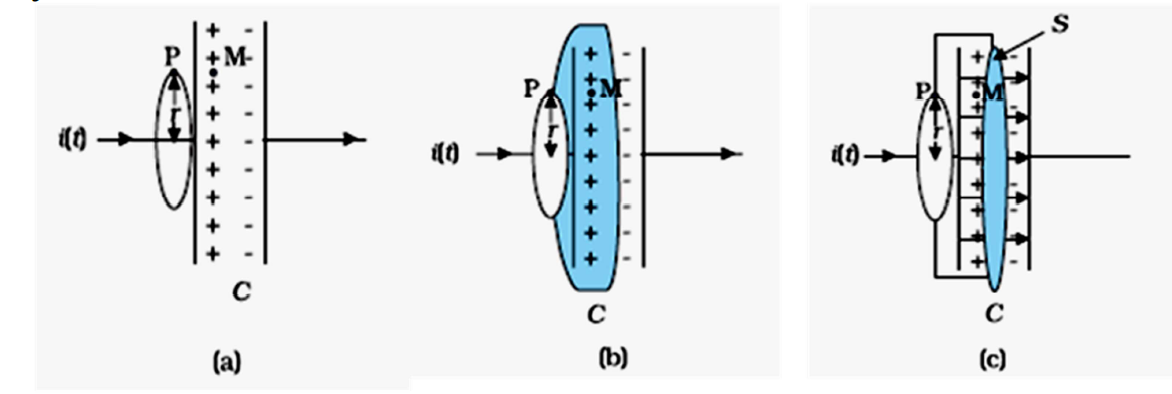 Applying ampere’s circuital law to fig (a) we see that, during charging, the right hand side in Ampere’s circuital law equals $\mu_{0}\text{I}$ However on applying it to the surfaces of the fig (b) or fig (c), the right hand side is zero. Hence, there is a contradiction. We can remove the contradiction by assuming that there exists a current (associated with the changing electric field during charging), known as the displacement current. When this current $( = \frac{\text{d}\phi_{E}}{\text{dt}})$ is added on the right-hand side, Ampere’s circuital law, the inconsistency disappears. It was, therefore necessary, to generalize the Ampere’s circuital law, as
 $\oint\overrightarrow{\text{B}}\text{d}\overrightarrow{\text{l}} = \mu_{0}\text{I}_{c} + \mu_{0}\in_{o}\frac{\text{d}\phi_{E}}{\text{dt}}.$
Generate a complete, print-ready paper with questions like this in minutes — across 16+ boards, with answer keys.