MCQ
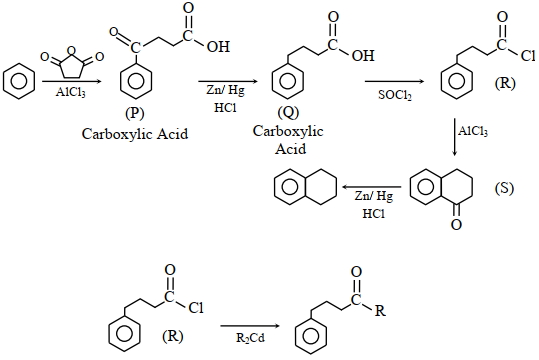
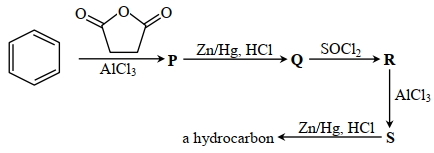
Considering the following reaction sequence, the correct statement(s) is(are)

$(A)$ Compounds $P$ and $Q$ are carboxylic acids.

$(B)$ Compound $S$ decolorizes bromine water.

$(C)$ Compounds $P$ and $S$ react with hydroxylamine to give the corresponding oximes.

$(D)$ Compound $R$ reacts with dialkylcadmium to give the corresponding tertiary alcohol.
  • A
    $A,B$
  • B
    $A,D$
  • $A,C$
  • D
    $A,B,C$

Answer

Correct option: C.
$A,C$
c

Need a full question paper?

Generate a complete, print-ready paper with questions like this in minutes — across 16+ boards, with answer keys.

Start Generating Free

Similar questions

How many strucural isomers of alcohols with the formula $C_4H_9OH$ are possible if all the carbon are in straight chain ?
(image) $\xrightarrow[35^oC]{LiAlH_4} A \xrightarrow[Excess]{CH_3MgBr} B$

 Identify $B$ in the reaction

The standard electrode potential for $Cu^{+2}/Cu$ is $0.34\, volt$ calculate the reduction potential at $pH = 14$ for the above couple ............... $\mathrm{V}$  $[K_{sp}[Cu(OH)_2) = 1 \times 10^{-19}]$
Which of the following oxide undergo disproportionate with $NaOH$ solution?
Cyanamide process is used in the formation of
Two reactions are given below:

$2 \mathrm{Fe}_{(\mathrm{s})}+\frac{3}{2} \mathrm{O}_{2(\mathrm{~g})} \rightarrow \mathrm{Fe}_2 \mathrm{O}_{3(\mathrm{~s})}, \Delta \mathrm{H}^{\mathrm{o}}=-822 \mathrm{~kJ} / \mathrm{mol}$

$\mathrm{C}_{(\mathrm{s})}+\frac{1}{2} \mathrm{O}_{2(\mathrm{~g})} \rightarrow \mathrm{CO}_{(\mathrm{g})}, \Delta \mathrm{H}^{\mathrm{o}}=-110 \mathrm{~kJ} / \mathrm{mol}$

Then enthalpy change for following reaction

$3\mathrm{C}_{(\mathrm{s})}+\mathrm{Fe}_2 \mathrm{O}_{3(\mathrm{~s})} \rightarrow 2 \mathrm{Fe}_{(\mathrm{s})}+3 \mathrm{CO}_{(\mathrm{g})}$

The solubility of $CaC{O_3}$ in water is $3.05 \times {10^{ - 4}}\,moles/litre.$ Its solubility product will be
Which of the following order is correct
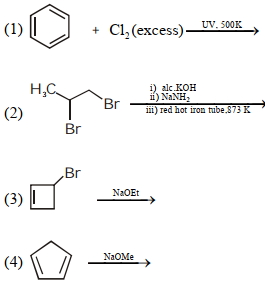
Choose the correct option($s$) that give($s$) an aromatic compound as the major product.
An exothermic reaction $X \rightarrow Y$ has an activation energy $30\, kJ \,mol ^{-1}$. If energy change $\Delta E$ during the reaction is $-20\, kJ ,$ then the activation energy for the reverse reaction in $kJ$ is $...$.(Integer answer)