MCQ
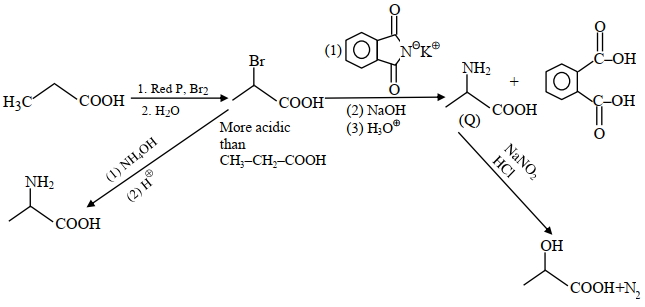
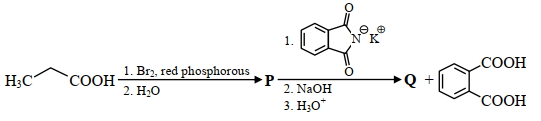
Considering the reaction sequence given below, the correct statement($s$) is(are)

$(A)$ $P$ can be reduced to a primary alcohol using $NaBH _4$.

$(B)$ Treating $P$ with conc. $NH _4 OH$ solution followed by acidification gives $Q$.

$(C)$ Treating $Q$ with a solution of $NaNO _2$ in aq. $HCl$ liberates $N _2$.

$(D)$ $P$ is more acidic than $CH _3 CH _2 COOH$.
  • $B,C,D$
  • B
    $B,C,A$
  • C
    $B,C$
  • D
    $B,D$

Answer

Correct option: A.
$B,C,D$
a

Need a full question paper?

Generate a complete, print-ready paper with questions like this in minutes — across 16+ boards, with answer keys.

Start Generating Free

Similar questions

Which is heaviest
Mohr's salt is
Chlorine reacts with sodium hydroxide under various condition to give
Consider the following transformation involving first order elementary reaction in each step at constant temperature as shown below.

$\mathrm{A}+\mathrm{B} \underset{\text { Step } 3}{\text { Step } 1} \mathrm{C} \xrightarrow{\text { Step } 2} \mathrm{P}$

Some details of the above reaction are listed below.

Step

Rate constant $\left(\sec ^{-1}\right)$

Activation energy 

$\left(\mathrm{kJ} \mathrm{mol}^{-1}\right)$

$1$ ${k}_1$ $300$
$2$ ${k}_2$ $200$
$3$ ${k}_3$ $\mathrm{Ea}_3$

If the overall rate constant of the above transformation (k) is given as $\mathrm{k}=\frac{\mathrm{k}_1 \mathrm{k}_2}{\mathrm{k}_3}$ and the overall activation energy $\left(E_2\right)$ is $400 \mathrm{~kJ} \mathrm{~mol}^{-1}$, then the value of $\mathrm{Ea}_3$ is $\qquad$ $\mathrm{kJ} \mathrm{mol}^{-1}$ (nearest integer)

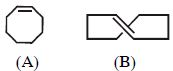
Relation between $(A)$ and $(B)$ is
$\begin{array}{*{20}{c}}
  {O\,\,\,\,\,\,\,\,\,\,\,\,\;\;\;\;\;\;\;\;\;\;\;\;\;\;\;\;\;\;\;\;\;\;\;\;\;\;\;\;\;\;\;\;\;\;\;\;\;\;\;\;\;\;\;\;\;\;\;\;\;\;\;} \\ 
  {||\,\,\,\,\,\,\,\,\,\,\,\,\;\;\;\;\;\;\;\;\;\;\;\;\;\;\;\;\;\;\;\;\;\;\;\;\;\;\;\;\;\;\;\;\;\;\;\;\;\;\;\;\;\;\;\;\;\;\;\;\;\;\;} \\ 
  {Ph - C - O - H + C{H_3} - {O^{18}} - H\xrightarrow{{{H^ + }}}(X) + {H_2}O} 
\end{array}$ Identify $X$
Assertion : Dinegative anion of oxygen $(O^{2-})$ is quite common but dinegative anion of sulphur $(S^{2-})$ is less common.

Reason : Covalency of oxygen is two.

Select the amphoteric substance in the following
An organic compound is boiled with alcoholic potash. The product is cooled and acidified with $HCl.$ A white solid separates out. The starting compound may be
When $C{H_3}C{H_2}CHC{l_2}$ is treated with $NaN{H_{2,}}$ the product formed is