Question
Construct a cumulative frequency distribution table from the frequency table given below:
Class Interval Frequency
$0 -8$ $9$
$8 - 16$ $13$
$16 - 24$ $12$
$24 - 32$ $7$
$32 - 40$ $15$

Answer

The cumulative frequency distribution table is
$C.I$ $c.f$
$0 -8$ $9$
$8 - 16$ $22$
$16 - 24$ $34$
$24 - 32$ $41$
$32 - 40$ $56$

Need a full question paper?

Generate a complete, print-ready paper with questions like this in minutes — across 16+ boards, with answer keys.

Start Generating Free

Similar questions

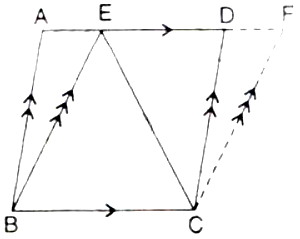
$\text{ABCD}$ and $\text{BCFE}$ are parallelograms. If area of triangle $EBC = 480 \ cm^2; AB = 30 \ cm$ and $BC = 40 \ cm.$

Calculate :$(i)$ Area of parallelogram $\text{ABCD};(ii)$ Area of the parallelogram $\text{BCFE};(iii)$ Length of altitude from $A$ on $CD;(iv)$Area of $\triangle ECF.$
$D$ and $E$ are points on the sides $A B$ and $A C$ of $\triangle A B C$ such that $D E \| B C$ and divides $\triangle A B C$ into two parts, equal in area. Find $\frac{ BD }{ AB }$.
In $\triangle ABC, E$ is the mid$-$point of the median $AD$, and $BE$ produced meets side $AC$ at point $Q$.Show that $BE: EQ = 3: 1.$
Solve, graphically, the following pairs of equations :$\frac{x+1}{4}=\frac{2}{3}(1-2 y);\frac{2+5 y}{3}=\frac{x}{7}-2$
$E, F, G,$ and $H$ are the midpoints of the sides of a parallelogram $\text{ABCD}$.Show that the area of quadrilateral $\text{EFGH}$ is half of the area of parallelogram $\text{ABCD}.$
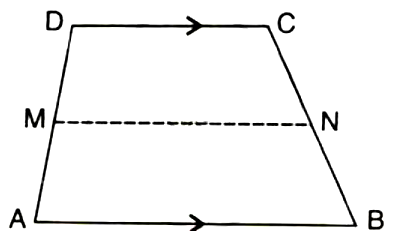
The figure, given below, shows a trapezium $\text{ABCD} . M$ and $N$ are the mid-point of the non$-$parallel sides $A D$ and $B C$ respectively. Find :

$(i) MN$, if $AB =11 \ cm$ and $DC =8 \ cm.(ii) A B$, if $D C=20 \ cm$ and $M N=27 \ cm.(iii) DC$, if $MN =15 \ cm$ and $AB =23 \ cm$.
A boat goes $18 \ km$ upstream in $3$ hours and $24 \ km$ downstream in $2$ hours. Find the speed of the boat in still water and the speed of the stream.
If $a -\frac{1}{ a }=7$, find $a ^2+\frac{1}{ a ^2}, a ^2-\frac{1}{ a ^2}$ and $a ^3-\frac{1}{ a ^3}$
Construct a trapezium $\text{ABCD}$, when:$AB= CD = 3.2 \ cm, BC = 6.0 \ cm, AD = 4.4 \ cm$ and $AD \| BC.$
If the equal sides of an isosceles triangle are produced, prove that the exterior angles so formed are obtuse and equal.