Question
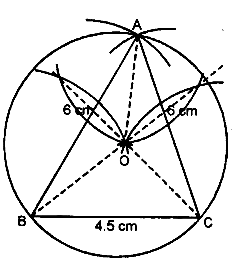
Construct a ∆ ABC such that AB = 6 cm, BC = 4.5 cm and AC = 5.5 cm. Construct a circumcircle of this triangle.
Answer

Steps of Construction :
(i) Draw a line segment $BC =4.5 cm$

(ii) With centre $B$ and radius $6 cm$, draw are arc
(iii) With centre $C$ and radius $5.5 cm$, draw another arc intersecting the first arc at $A$.
(iv) Join $A B$ and $A C$.
$\triangle ABC$ is the required triangle.
(v) Draw the perpendicular bisectors of $A B$ and $A C$. Which intersects each other at $O$.
(vi) Join $O B, O C$ and $O A$.
(vii) With centre $O$ and radius $OA$, draw a circle which passes through A, B and C.
This is the required circumcircle of $\triangle A B C$.

Need a full question paper?

Generate a complete, print-ready paper with questions like this in minutes — across 16+ boards, with answer keys.
Start Generating Free

Similar questions

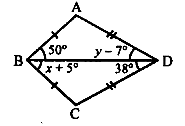
Use the information given in the following figure to prove triangles $A B D$ and $C B D$ are congruent. Also, find the values of $x$ and $y$.
Ten cards with numbers 1 to 10 written on them are placed in a bag. A card is chosen from the bag at random. Determine the probability of choosing:
(i) 7
(ii) 9 or 10
(iii) a number greater than 4
(iv) a number less than 6
Construct an equilateral ∆ DEF whose one side is 5.5 cm. Construct an incircle to this triangle.
Triangle PQR is right-angled at vertex R. Calculate the length of PR, if: PQ = 34 cm and QR = 33.6 cm.
Construct an isosceles ∆ MNP such that base MN = 5.8 cm, base angle MNP = 30°. Construct an incircle to this triangle and measure its radius.
Arrange the given rational numbers in descending order:
$\frac{3}{-10}, \frac{-13}{30} \text { and } \frac{8}{-20}$
The following table gives the weights (in grams) of 30 boxes of fruits :
Weight (in grams) 350425500375475400450
Number of boxes 5364237
Find the mean and the median.
Using empirical formula, calculate its mode.
Radhika is in the Chemistry Laboratory and is working on a practical. She mixed three salts A, B and C taking 150 gm of A and 300 gm each of B and C to prepare a mixture X.
Q.1. The percentage of salt A in mixture X is:
(a) 15% $\quad$$\quad$(b) 20% $\quad$$\quad$(c) 25%$\quad$$\quad$ (d) 30%
Q.2. By what percent is salt C more than salt A in mixture X?
(a) 50% $\quad$$\quad$(b) 100%$\quad$$\quad$ (c) 150% $\quad$$\quad$(d) 200%
Q.3. Radhika added 250 gm of salt B to mixture X to prepare a new mixture Y. By what per cent did salt B increase
(a) $63 \frac{1}{3} \%$$\quad$$\quad$ (b) $75 \%$ $\quad$$\quad$(c) $83 \frac{1}{3} \%$ $\quad$$\quad$(d) $121 \%$
Q.4. The percentage of salt A in mixture Y is :
(a) $15 \%$ $\quad$$\quad$(b) $17 \frac{1}{2} \%$ $\quad$$\quad$(c) $20 \%$$\quad$$\quad$ (d) $22 \frac{1}{2} \%$
Evaluate: $-5+\frac{5}{-8}+\frac{-5}{-12}$
A boy first goes 5 m due north and then 12 m due east. Find the distance between the initial and the final position of the boy.