Question
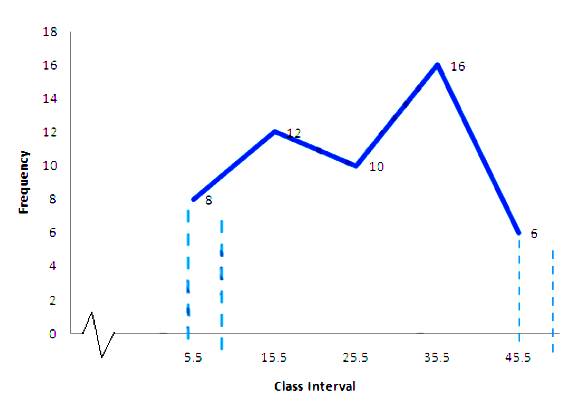
Construct a frequency polygon without using a histogram for the following frequency distribution :
Class Interval 1-10 11-20 21-30 31-40 41-50
Frequency 8 12 10 16 6

Answer

Steps:
1. Make the class intervals continuous by subtracting 0.5 from the lower limit of each class and add 0.5 to the upper limit of each class.
2. Find class mark by calculating the average of the class interval.
3. On the $x$-axis, take $1 \mathrm{~cm}$ as 5 units and plot class interval.
4. On the $y$-axis, take $1 \mathrm{~cm}$ as 5 units and plot frequency.
5. Plot the points on the graph. $(5.5,8),(15.5,12),(25.5,10),(35.5,16),(45.5,6)$.
6. Mark two more midpoints of zero frequency on $x$-axis at the start and at the end.
7. Now connect the points using straight lines.
Class Interval Class Mark Frequency
0.5-10.5 $
=\frac{0.5+10.5}{2}=5.5
$
8
10.5-20.5 $
=\frac{10.5+20.5}{2}=15.5
$
12
20.5-30.5 $
=\frac{20.5+30.5}{2}=25.5
$
10
30.5-40.5 $
=\frac{30.5+40.5}{2}=35.5
$
16
40.5-50.5 $
=\frac{40.5+50.5}{2}=45.5
$
6

Need a full question paper?

Generate a complete, print-ready paper with questions like this in minutes — across 16+ boards, with answer keys.

Start Generating Free

Similar questions

Find the point on the x-axis equidistant from the points $(5,4)$ and $(-2,3).$
The origin $o (0, O), P (-6, 9)$ and $Q (12, -3)$ are vertices of triangle $OPQ.$ Point M divides $OP$ in the ratio $1: 2$ and point $N$ divides $OQ$ in the ratio $1: 2.$ Find the coordinates of points M and N. Also, show that $3MN = PQ.$
If the midpoints of the sides ofa triangle are $(-2, 3), (4, -3), (4, 5),$ find its vertices.
Take a graph paper and mark the points A(2,0), B(2,8) and C(S,4) on it. Taking AB as the line of symmetry, obtain and write the co-ordinates of point D. Complete the quadrilateral ABCD and give its geometrical name.
Prove the following identitie:
$\frac{\sin A-\cos A+1}{\sin A+\cos A-1}=\frac{\cos A}{1-\sin A}$
Two circles touch each other externally. The sum of their areas is $5811 cm^2$​​​​​​​ and the distance between their centres is $10 \ cm$. Find the radii of the two circles.
In Δ ABC, ∠ABC = ∠DAC. AB = 8 cm, AC = 4 cm, AD = 5 cm.
1) Prove that ΔACD is similar to ΔBCA.
2) Find BC and CD
3) Find area of ΔACD: area of ΔBCA
A company with 10,000 shares of nominal value Rs 100 declares an annual dividend of 8% to the shareholders
1) Calculate the total amount of dividend paid by the company.
2) Ramesh had bought 90 shares of the company at Rs 150 per share. Calculate the dividend he receives and the percentage of return on his investment.
$A(8,2)$ and $B(6,4)$ are the vertices of a figure which is symmetrical about $x = 6$ and $y = 2.$ Complete the figure and give the geometrical name of the figure.
Given $\left[\begin{array}{cc}2 & 1 \\ -3 & 4\end{array}\right] x=\left[\begin{array}{l}7 \\ 6\end{array}\right]$ Write the matrix $x$