Question
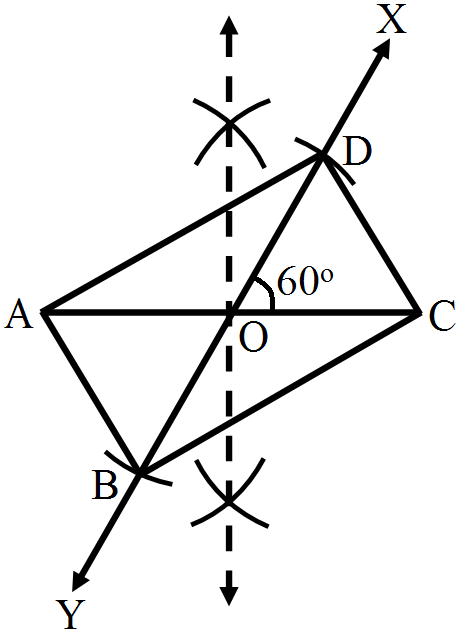
Construct a parallelogram ABCD, in which diagonal AC = 3.8cm, diagonal BD = 4.6cm and the angle between AC and BD is 60°.
Answer

We know that the diagonals of a parallelogram bisect each other.
Steps of construction:
Step 1: Draw AC = 3.8cm. Step 2: Bisect AC at O. Step 3: Make $\angle\text{COX}=60^\circ$ Produce XO to Y.Step 4:
$\text{OB}=\frac{1}{2}(4.6)\text{cm}$ $\text{OB}=2.3\text{cm}$ and $\text{OD}=\frac{1}{2}(4.6)\text{cm}$ $\text{OD}=2.3\text{cm}$ Step 5: Join AB, BC, CD and AD. ​Thus, ABCD is the required parallelogram.

Need a full question paper?

Generate a complete, print-ready paper with questions like this in minutes — across 16+ boards, with answer keys.

Start Generating Free

Similar questions

If $\text{x}+\frac{1}{\text{x}}=12,$ find the value of $\text{x}−\frac{1}{\text{x}}.$
Measure of one angle of a rhombus is 50°, find the measures of remaining three angles.
In the following table, data of the transport means used by students in 8th standard for commutation between home and school is given. Draw a subdivided bar diagram to show the data.
(Scale: On Y axis: 1 cm = 500 students)
Means of commutation\TownPaithanYeolaShahapur
Cycle325015001250
Bus and auto750500500
On foot10001000500
Construct a quadrilateral ABCD in which AB = 4.4cm, BC = 4cm, CD = 6.4cm, DA = 3.8cm and BD = 6.6cm.
Construct a quadrilateral ABCD in which AB = BC = 6cm, AD = DC = 4.5cm and $\angle\text{B}=120^\circ.$
Five years ago a man was seven times as old as his son. Five years hence, the father will be three times as old as his son. Find their present ages.
Find the area of a trapezium whose parallel sides of lengths 10cm and 15cm are at a distance of 6cm from each other. Calculate this area as:
  1. The sum of the areas of two triangles and one rectangle.
  2. The difference of the area of a rectangle and the sum of the areas of two triangles.
Solve the following equation and also check your result in case:
$\Big[(2\text{x}+3)+(\text{x+5})\Big]^2+\Big[(2\text{x}+3)-(\text{x}+5)\Big]^2=10\text{x}^2+92$
Construct a quadrilateral PQRS, where PQ = 3.5cm, QR = 6.5cm, $\angle\text{P}=\angle\text{R}=105^\circ$ and $\angle\text{S}=75^\circ$
Find the following product and verify the result for $x=-1, y=-2$ :
$\left(x^2 y-1\right)\left(3-2 x^2 y\right)$