Question
Construct a quadrilateral $ABCD$ given $AD = 5\ cm, AB = 5.5\ cm, BC = 2.5\ cm, AC = 7.1\ cm$ and $BD = 8\ cm$.
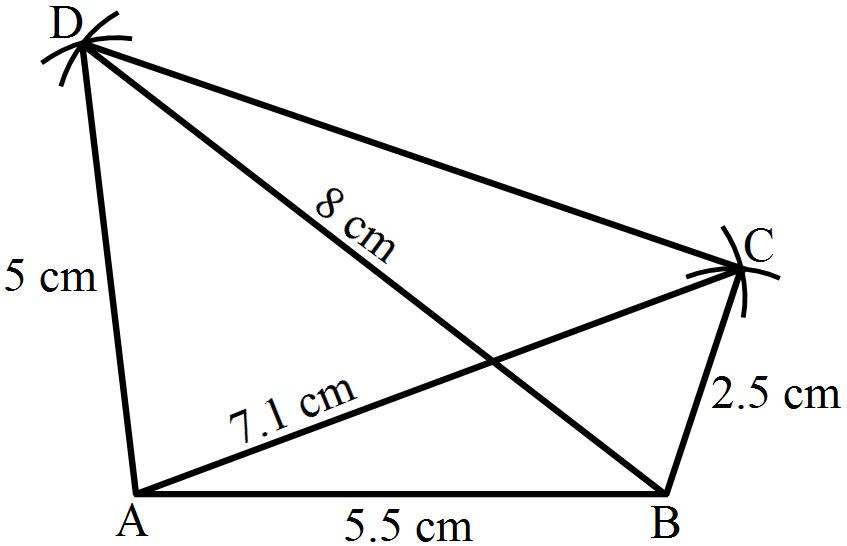
Answer


Steps of construction:
Step $I$: Draw $AB = 5.5\ cm$.
Step $II$: With $A$ as the centre and radius $7.1\ cm$, draw an arc.
Step $III$: With $B$ as the centre and radius $2.5\ cm$, draw an arc to intersect the arc drawn in Step $II$ at $C$.
Step $IV$: With $B$ as the centre and radius $8\ cm$, draw an arc.
Step $V$: With $A$ as the centre and radius $5\ cm$, draw an arc to intersect the arc drawn in Step $IV$ at $D$.
Step $VI$: Join $DA, DB, BC, AC$ and $CD$ to obtain the required quadrilateral.

Need a full question paper?

Generate a complete, print-ready paper with questions like this in minutes — across 16+ boards, with answer keys.

Start Generating Free

Similar questions

The diameter of a wheel of a bus is $90\ cm$ which makes $315$ revolutions per minute. Determine its speed in kilometres per hour. $\Big(\text{Take }\pi=\frac{22}{7}\Big)$
Find the volume, lateral surface area and the total surface area of the cuboid whose dimensions are:
Length $= 15\ m$, breadth $= 6\ m$ and height $= 9\ dm.$
The marks obtained (out of 20) by 30 students of a class in a test are given below: $7, 10, 8, 16, 13, 14, 15, 11, 18, 11, 15, 10, 7, 14,$ $20, 19, 15, 16, 14, 20, 10, 11, 14, 17, 13, 12, 15, 14, 16, 17.$ Prepare a frequency distribution table for the above data using class intervals of equal width in which one class interval in $3-8$ (including $2$ and excluding $8$). From the frequency distribution table so obtained, draw a histogram.
Find the difference between the compound interest and simpal interest, On a sum of $Rs. 50,000$ at 10% per annum for $2$ years.
Solve the following equation and also check your result in case: $\frac{3\text{a}-2}{3}=\frac{2\text{a}+3}{2}=\text{a}+\frac{7}{6}$
Find 3 examples where the product of two numbers remains unchanged when one of them is increased by 2 and the other is decreased by 4.
Solve the following equation and also check your result in case:
$\Big[(2\text{x}+3)+(\text{x+5})\Big]^2+\Big[(2\text{x}+3)-(\text{x}+5)\Big]^2=10\text{x}^2+92$
Multiply the following :
$\left(x^2-5 x+6\right),(2 x+7)$
Complite the following tables given that $x$ varies directly as $y$.
$x$
$5$
$...$
$10$
$35$
$25$
$...$
$y$
$8$
$12$
$...$
$...$
$...$
$32$
Construct a parallelogram $\text{HOME}$ with $\text{HO} = 6\ cm, \text{HE} = 4\ cm$ and $\text{OE} = 3\ cm$.