Question
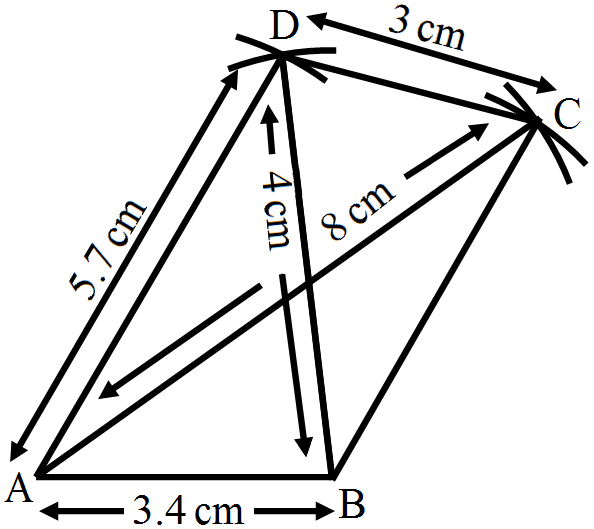
construct a quadrilateral $ABCD$ in which $AB = 3.4\ cm, CD = 3\ cm, DA = 5.7\ cm, AC = 8\ cm$ and $BD = 4\ cm.$
Answer


Steps of construction:
Step 1: Draw $AB = 3.4\ cm.$
Step 2: With $B$ as the centre and radius equal to $4\ cm,$ draw an arc.
Step 3: With $A$ as the centre and radius equal to $5.7\ cm,$ draw another arc, cutting the previous arc at $D.$​​​​​​​
Step 4: Join $BD$ and $AD.$​​​​​​​
Step 5: With $A$ as the centre and radius equal to $8\ cm,$ draw an arc.
Step 6: With $D$ as the centre and radius equal to $3\ cm,$ draw another arc, cutting the previous arc at $C.$​​​​​​​
Step 7: Join $AC, CD$ and $BC.$
Thus, $ABCD$ is the required quadrilateral.

Need a full question paper?

Generate a complete, print-ready paper with questions like this in minutes — across 16+ boards, with answer keys.
Start Generating Free

Similar questions


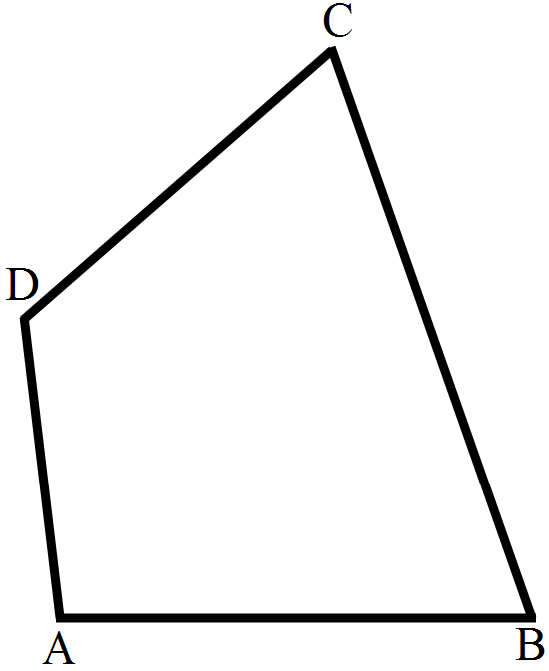
In the figure, $\text{ABCD}$ is a quadrilateral.
$i.$ Name a pair of adjacent sides.
$ii.$ Name a pair of opposite sides.
$iii.$ How many pairs of adjacent sides are there?
$iv.$ How many pairs of Opposite sides are there?
$v.$ Name a pair of adjacent angles.
$vi.$ Name a pair of opposite angles.
$vii.$ How many pairs of adjacent angles are there?
$viii.$ How many pairs of opposite angles are there?
Solve the following equation and also check your result in case: $\frac{6\text{x}+1}{2}+1=\frac{7\text{x}-3}{3}$
Solve the following equation and verify your answer: $\frac{2\text{x}-3}{3\text{x}+2}=-\frac{2}{3}$
Construct a quadrilateral $ABCD,$ where$\angle\text{A}=65^\circ,\text{B}=105^\circ,\text{C}=75^\circ,$ $BC = 5.7$ and $CD = 6.8\ cm$.
Find the volume, lateral surface area and the total surface area of the cuboid whose dimensions are:
Length $= 15\ m$, breadth $= 6\ m$ and height $= 9\ dm.$
A bag contains $3$ red balls, $5$ black balls and $4$ white balls. A ball is drawn at random from the bag. What is the probability that the ball drawn is:
$i.$ white?
$ii.$ red?
$iii.$ black?
$iv.$ not red?
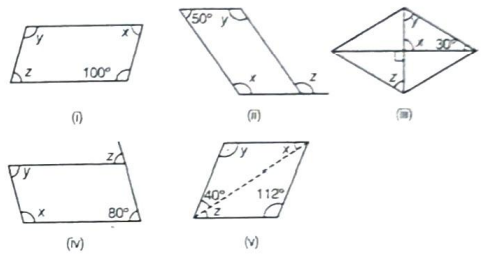
Consider the following parallelograms. Find the values of the unknowns $x, y$ and $z$
Image
A well with $14m$ diameter is dug $8m$ deep. The earth taken out of it has been evenly spread all around it to a width of $21m$ to form an embankment. Find the height of the embankment.
Solve the following equation and verify your answer: $\frac{\text{y}-(7-8\text{y})}{9\text{y}-(3+4\text{y})}=\frac{2}{3}$
The following chart gives the growth in height
(in terms of percentage) of boys and girls with their respective ages:
Age (in yr)BoysGirls
872%77%
975%81%
1078%84%
1181%88%
1284%91%
1388%95%
1492%98%
1595%99%
1698%99.5%
1799%100%
18100%100%
Draw the line graph of above data on the same sheet and answer the following question
(i) In which year both the boys and the girls achieve their maximum height?
(ii) Who grows faster at puberty (14-16 yr of age)?