Question
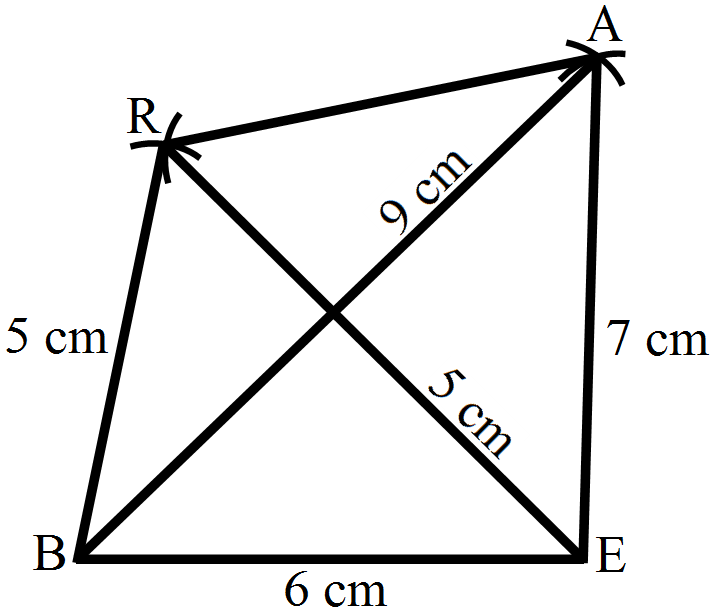
Construct a quadrilateral $\text{BEAR}$ in which $\text{BE} = 6\ cm, \text{EA} = 7\ cm, \text{RB = RE} = 5\ cm$ and $\text{BA} = 9\ cm$. Measure its fourth side.
Answer


Steps of Construction:
$1.$ Draw a line segment $\text{BE} = 6\ cm$
$2.$ With B as centre, draw an arc $\text{BR} = 5\ cm$ and with $E$ as centre , draw an arc $\text{EA} = 7\ cm$.
$3.$ Now, draw an another arc $\text{BA} = 9\ cm$ with $B$ as a centre which cut$-$off arc $\text{AE}$.
$4.$ Draw an another arc $\text{ER} = 5\ cm$ with $E$ as centre, which cut$-$off arc $\text{BR}$.
$5.$ Now join $\text{BR, EA}$ and $\text{AR}$.
Thus, we have required quadrilateral $\text{BEAR}$. Also, $\text{AR} = 5\ cm$.

Need a full question paper?

Generate a complete, print-ready paper with questions like this in minutes — across 16+ boards, with answer keys.

Start Generating Free

Similar questions

Verify commutativty of addition of rational numbers for the following pairs of rotional number:
$4$ and $\frac{-3}{5}$
An altitude of a triangle is five-thirds thelength of its corresponding base. If the altitude be increased by $4\ cm$ and the base decreased by $2\ cm$, the area of the triangle remains the same. Find the base and the altitude of the triangle.
A company sells biscuits. For packing purpose they are using cuboidal boxes : Box $A \rightarrow 3 cm \times 8 cm \times 20 cm$ and Box $B \rightarrow 4 cm \times 12 cm \times 10 cm$. What size of the box will be economical for the company? Why? Can you suggest any other size (dimensions) which has the same volume but is more economical than these?
Verify the following: $-1+\Big(\frac{-2}{3}+\frac{-3}{4}\Big)=\Big(-1+\frac{-2}{3}\Big)+\frac{-3}{4}$
By what numbers should the following be divided to get a perfect square in case? Also, find the number whose square is the new number.$1575$
Find the amount and the compound interest on $Rs. 160000$ for $2$ years at $10\%$ per annum, compounded half-yearly.
Predicting the ones digit, copy and complete this table and answer the questions that follow.
$x$
$1^x$
$2^x$
$3^x$
$4^x$
$5^x$
$6^x$
$7^x$
$8^x$
$9^x$
$10^x$
$1$
$1$
$2$


$2$
$1$
$4$


$3$
$1$
$8$


$4$
$1$
$16$


$5$
$1$
$32$


$6$
$1$
$64$


$7$
$1$
$128$


$8$
$1$
$256$


Ones Digit of the Powers
$1$
$2, 4, 8, 6$


$a.$ Describe patterns you see in the ones digits of the powers.
$b.$ Predict the ones digit in the following:
$i. 4^{12}$
$ii. 9^{20}$
$iii. 3^{17}$
$iv. 5^{100}$
$v. 10^{500}$
$c.$ Predict the ones digit in the following:
$i. 31^{10}$
$ii. 12^{10}$
$iii.17^{21}$
$iv. 29^{10}$
A field is $150m$ long and $100m$ wide. A plot (outside the field) $50m$ long and $30m$ wide is dug to a depth of $8m$ and the earth taken out from the plot is spread evenly in the field. By how much the level of field is raised?
Represent the following data with the help of a pie-diagram:
Items
Wheat
Rice
Tea
Production (in metric tons)
$3260$
$1840$
$900$
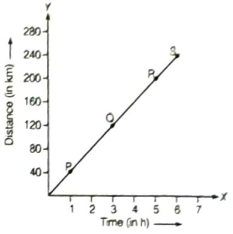
Study the distance-time graph given below for a car to travel to certain places and answer the questions that follow.
(i) How far does the car travel in 2 h ?
(ii) How much time does the car take to reach $R$ ?
(iii) How long does the car take to cover 80 km ?
(iv) How far is Qfrom the starting point?
(v) When does the car reach the place Safter starting?
Image