Question
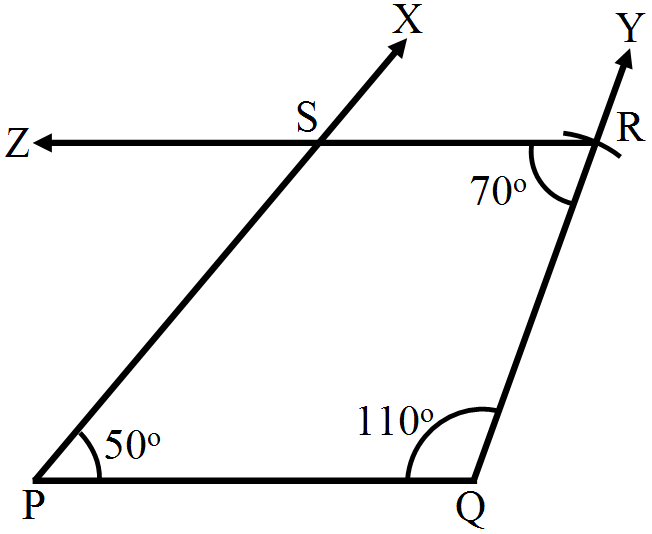
Construct a quadrilateral $PQRS$, in which $PQ = 4\ cm, QR = 5\ cm$, $\angle\text{P}=50^\circ,\angle\text{P}=110^\circ$ and $\angle\text{R}=70^\circ.$
Answer


Steps of construction:
Step $I$: Draw $PQ = 4\ cm$.
Step $II$: Construct $\angle\text{XPQ}=50^\circ$ at $P$ and $\angle\text{PQY}=110^\circ$ at $Q$.
Step $III$: With $Q$ as the centre and radius $5\ cm$, cut off $QR = 5\ cm$.
Step $IV$: At $R$, draw $\angle\text{QRZ}=70^\circ$ such that it meets $PX$ at $S$.
The quadrilateral so obtained is the required quadrilateral.

Need a full question paper?

Generate a complete, print-ready paper with questions like this in minutes — across 16+ boards, with answer keys.

Start Generating Free

Similar questions

Construct a quadrilateral $PQRS$ in which $PQ = 4.2\ cm,$ $\angle\text{PQR}=60^\circ,\angle\text{QPS}=120^\circ,$ $QR = 5\ cm$ and $PS = 6\ cm.$
All the angles of a quadrilateral are equal to each other. Find the measure of each. Is the quadrilateral a parallelogram? What special type of parallelogram is it?
Which of the following numbers are perfect squares? $11, 12, 16, 32, 36, 50, 64, 79, 81, 111, 121.$
A cylindrical vessel, without lid, has to be tin-coated on its both sides. If the radius of the base is $70\ cm$ and its height is $1.4m$, calculate the cost of tin - coating at the rate of $Rs\ 3.50$ per $1000\ cm^2$.
The volume and the curved surface area of a cylinder are $1650 \ cm^3$ and $660 \ cm^2$ respectively. Find the radius and height of the cylinder.
By what number should the following numbers be multiplied to get a perfect square in each case? Also, find the number whose square is the new number. $4056$
Study the table given below and draw a line graph for it.
Side of the square (in cm)
$2$
$3$
$3.5$
$5$
$6$
Perimeter (in cm)
$8$
$12$
$14$
$20$
$24$
Is the graph drawn, a linear graph?
A rectangular sheet of paper is rolled in two different ways to form two different cylinders. Find the volume of cylinders in each case if the sheet measures $44\ cm \times 33\ cm$.
Find the difference between Compound Interest and Simple Interest on $Rs. 45,000$ at $12\%$ per annum for $5$ years.
Find whether, or not the first polynomial is a factor of the second:
$\frac{3\text{y}^3+5\text{y}^2+5\text{y}+2}{\text{y}-2}$