Question
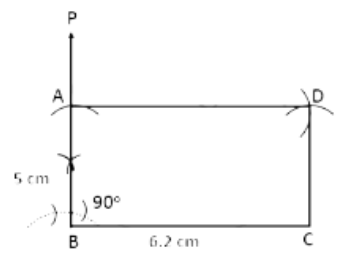
Construct a rectangle $\text{ABCD}$, when $AB = 5\ cm$ and $BC = 6.2\ cm.$
Answer

Steps of construction:
$1$. Draw $B C=6.2 \ cm$
$2$. Through $B$, draw $B P$ such that $\angle B=90^{\circ}$
$3$. From $B P$, cut $B A=5 \ cm$
$4$. With $A$ and $C$ as centres and radii $6.2 \ cm$ and $5 \ cm$ respectively, draw arcs cutting each other at $D$.
$5$. Join $A D$ and $C D$.
Thus, $\text{ABCD}$ is the required triangle.Image

Need a full question paper?

Generate a complete, print-ready paper with questions like this in minutes — across 16+ boards, with answer keys.
Start Generating Free

Similar questions

Given $: \tan A =\frac{4}{3}$, find $: \frac{\operatorname{cosecA}}{\cot A -\sec A }$
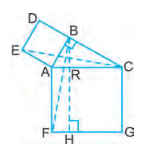
In the given figure, squares ABDE and AFGC are drawn on the side $A B$ and hypotenuse $A C$ of right triangle $A B C$ and $BH \perp FG$. Prove that :
(i) $\triangle EAC \cong \triangle BAF$.
(ii) $\operatorname{ar}($ sq. ABDE $)= ar ($ rect. ARHF $)$.
Image
Draw a graph of each of the following equations: $2(x-5)=\frac{3}{4}(y-1)$
The weights in grams of 50 apples picked at random from a consignment are as follows : 131, 113, 82, 75, 204, 81, 84, 118, 104, 110, 80, 107, 111, 141, 136, 123, 90, 78, 90, 115, 110, 98, 106, 99, 107, 84, 76, 186, 82, 100, 109, 128, 115, 107, 115, 119, 93, 187, 139, 129, 130, 68, 195, 123, 125, 111, 92, 86, 70, 126
Form the grouped frequency table by dividing the variable range into intervals of equ width of 20 g.
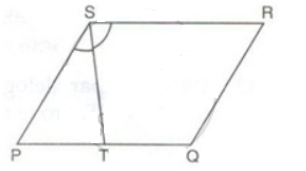
$\text{PQRS}$ is a parallelogram. $T$ is the mid$-$point of $PQ$ and $ST$ bisects $\angle PSR.$
Image
Prove that: $QR = QT$
$ABC$ is a triangle. The bisector of the $\angle BCA$ meets $AB$ in $X$. A point $Y$ lies on $CX$ such that $AX = AY$.Prove that: $\angle CAY = \angle ABC.$
The following table shows the marks obtained by the students of a class in an examination.
Marks0 - 1010 - 2020 - 3030 - 4040 - 50
No. of students1532553513
Draw a frequency polygon.
If 11 pens and 19 pencils together cost ₹ 502; while 19 pens and 11 pencils together cost ₹ 758, how much 3 pens and 6 pencils cost together?
The internal length, breadth, and height of a box are $30 \ cm, 24 \ cm,$ and $15 \ cm$. Find the largest number of cubes which can be placed inside this box if the edge of each cube is$(i) 3 \ cm (ii) 4 \ cm (iii) 5 \ cm$
In $\triangle ABC; \angle ABC = 90^o$and $P$ is a point on $AC$ such that $\angle PBC = \angle PCB.$Show that:$PA = PB.$