Question
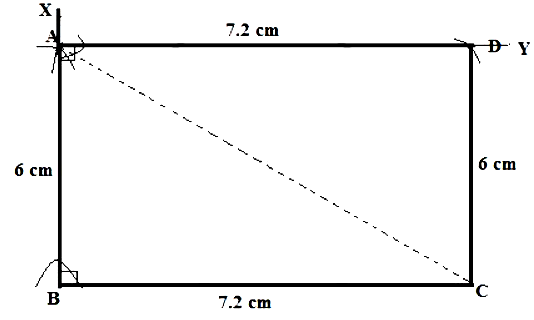
Construct a rectangle $\text{ABCD,}$ when:Its sides are $6.0 \ cm$ and $7.2 \ cm.$

Answer

Since each angle of a rectangle is $90^{\circ}$ and the opposite sides are equal.
Therefore,

Steps:
$1.$ Draw $BC =7.2 \ cm$.
$2.$ With $B$ as a centre draw a line $BX$ taking as a $90^{\circ}$.
$3. $Now taking radius $6 \ cm$ to draw an arc at $A$.
$4.$ From the point, $A$ draw a line $A Y$ parallel to $B C$.
$5.$ With $A$ as a center taking radius $7.2 \ cm$ to draw an arc at $D$.
$6.$ Now join $C D$.
$\text{ABCD}$ is the required rectangle.

Need a full question paper?

Generate a complete, print-ready paper with questions like this in minutes — across 16+ boards, with answer keys.
Start Generating Free

Similar questions

If $\left(a^2+\frac{1}{a^2}\right)=23$, find the values of: (i) $\left(a+\frac{1}{a}\right)$ (ii) $\left(a^3+\frac{1}{a^3}\right)$.
The perimeter of a rhombus is $52 \ cm$. If one diagonal is $24 \ cm$; find:$(i)$ The length of its other diagonal,$(ii)$ Its area.
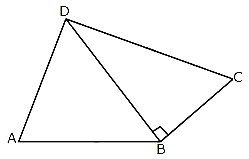
Find the area and the perimeter of quadrilateral $\ce{ABCD},$ given below; if $AB = 8 \ cm, AD = 10 \ cm, BD = 12 \ cm, DC = 13 \ cm$ and $\angle DBC = 90^\circ .$
In right$-$angled triangle $ABC; \angle B = 90^\circ.$ Find the magnitude of angle $A,$ if:$BC$ is $\sqrt{3}$ times of $AB.$
Simplify the following:$12 \log \frac{3}{2}+7 \log \frac{125}{27}-5 \log \frac{25}{36}-7 \log 25+\log \frac{16}{3}$
The radius of a circle is $17.0 \ cm$ and the length of the perpendicular drawn from its center to a chord is $8.0 \ cm.$
Calculate the length of the chord.
In an equilateral $\triangle ABC$; points $P, Q$ and $R$ are taken on the sides $AB, BC$ and $CA$ respectively such that $AP = BQ = CR$. Prove that $\triangle PQR$ is equilateral.
In a parallelogram $\text{ABCD, M}$ is the mid$-$point $AC. X$ and $Y$ are the points on $AB$ and $DC$ respectively such that $AX = CY$. Prove that:$(i)$ Triangle $\text{AXM}$ is congruent to $\triangle CYM$, and;$(ii) \text{XMY}$ is a straight line.
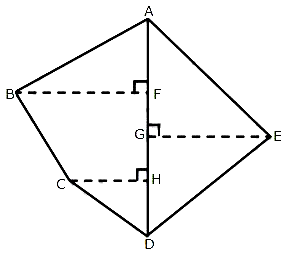
The following diagram shows a pentagonal field $\text{ABCDE}$ in which the lengths of $AF, FG, GH,$ and $HD$ are$ 50\ m, 40\ m, 15\ m$ and $25\ m$ respectively; and the lengths of perpendiculars $BF, CH$ and $EG$ are $50\ m, 25\ m$ and $60\ m$ respectively.Determine the area of the field.
Simplify the following$\frac{3}{5-\sqrt{3}}+\frac{2}{5+\sqrt{3}}$