Question
Construct a rectangle PQRS by taking two convenient adjacent sides. Name the point of intersection of diagonals as T. Using divider and ruler, measure the following lengths.
i. lengths of opposite sides, seg QR and seg PS.
ii. lengths of seg PQ and seg SR.
iii. lengths of diagonals PR and QS.
iv. lengths of seg PT and seg TR, which are parts of the diagonal PR.
v. lengths of seg QT and seg TS, which are parts of the diagonal QS.
Observe the measures. Discuss about the measures obtained by your classmates.
Answer

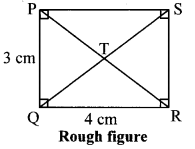
Draw a rectangle PQRS such that, l(PQ) = 3 cm and l(QR) = 4 cm.
Image
Steps of construction :
i. As shown in the rough figure, draw seg QR of length 4 cm.
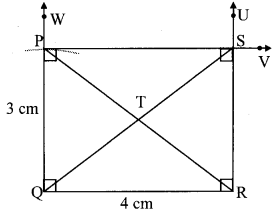
ii. Placing the centre of the protractor at point Q, draw ray QW making an angle of 90° with seg QR.
iii. By taking a distance of 3 cm on the compass and placing it at point Q, draw an arc on ray QW. Name the point as P.
iv. Draw ray PV and ray RU making an angle of 90° with seg PQ and seg QR respectively.
v. Name the point of intersection of ray PV and ray RU as S.
₹PQRS is the required rectangle.
Image
From the figure,
i. l(QR) = l(PS) = 4 cm
ii. l(PQ) = l(SR) = 3 cm
iii. l(PR) = l(QS) = 5 cm
iv. l(PT) = l(TR) = 2.5 cm
v. l(QT) = l(TS) = 2.5 cm

From the above measures, we can say that for any rectangle,
i. Opposite sides are congruent.
ii. Diagonals are congruent.
iii. Diagonals bisect each other.

Need a full question paper?

Generate a complete, print-ready paper with questions like this in minutes — across 16+ boards, with answer keys.

Start Generating Free

Similar questions

Find the smallest number that must be subtracted from those of the numbers which are not perfect cubes, to make them perfect cubes. What are the corresponding cube roots?
  1. 130
  2. 345
  3. 792
  4. 1331
Draw an obtuse angled ∆STV. Draw its medians and show the centroid.
The ages (in years) of 360 patients treated in a hospital on a particular day are given below:
Age (in years)
10-20
20-30
30-40
40-50
50-60
60-70
Number of patiets
90
40
60
20
120
30
Draw a histogram for the given data.
Hint. Take 10 small divisions = 10 patients.
Show that each diagonal of a rhombus bisects the angle through which it passes.
Observe the following pattern,
$2^2-1^2=2+1$
$3^2-2^2=3+2$
$4^2-3^2=4+3$
$5^2-4^2=5+4$
and find the value of,
i. $100^2-99^2$
ii. $111^2-109^2$
iii. $99^2-96^2$
Following figures relate to the weekly wages (in Rs) of 15 workers in a factory: 300, 250, 200, 250, 200, 150, 350, 200, 250, 200, 150, 300, 150, 200, 250.Prepare a frequency table:
  1. What is the range in wages (in Rs)?
  2. How many workers are getting Rs 350?
  3. How many workers are getting the minimum wages?
Find the following product and verify the result for $x=-1, y=-2$ :
$\left(x^2 y-1\right)\left(3-2 x^2 y\right)$
A cistern has two inlets A and B which can fill it in 12 hours and 15 hours respectively. An outlet can empty the full cistern in 10 hours. If all the three pipes are opened together in the empty cistern, how much time will they take to fill the cistern completely?
Draw an obtuse angled ∆LMN. Draw its altitudes and denote the ortho centre by ‘O’.
$(\text{x}+2)(\text{x}+3)+(\text{x}-3)(\text{x}-2)-2\text{x}(\text{x}+1)=0$