Question
Construct a rectangle whose adjacent sides are of lengths $5\ cm$ and $3.5\ cm.$

Answer

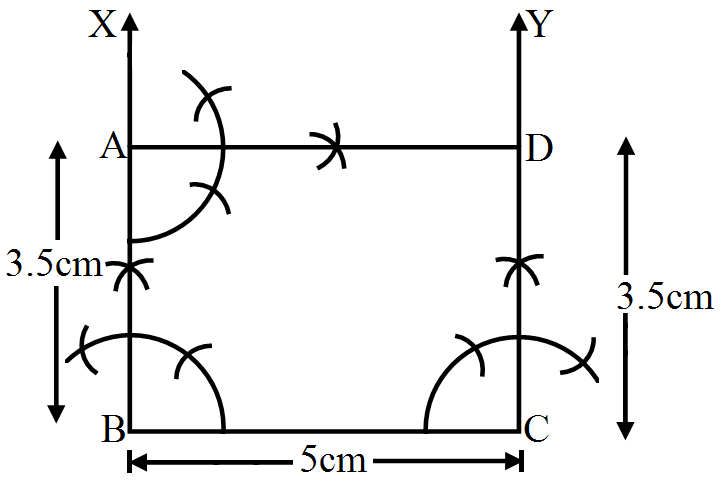
We know that, each angle of a rectangle is right angle (i.e., $90^{\circ}$ ) and its opposite sides are equal and parallel. To construct a rectangle whose adjacent sides are of lengths $5 cm$ and $3.5 cm$ , use the $1$ following steps.
1. Draw a line segment $B C$ of length $5 cm .$
2. Now, generate an angle of $90^{\circ}$ at points $B$ and $C$ of the line segment $B C$ and plot the parallel lines $B X$ and $C Y$ at these points. .

3. Cut $A B$ and $C D$ of length $3.5 \ cm$ from $B X$ and $C Y$, respectively.
4. Draw an angle $90^{\circ}$ at one of the point $A$ or $D$ and join both points by a line segment $A D$ of length $5 \ cm$ . Thus, $A B C D$ is the required rectangle with adjacent sides of length $5 \ cm$ and $3.5 \ cm$ .

Need a full question paper?

Generate a complete, print-ready paper with questions like this in minutes — across 16+ boards, with answer keys.
Start Generating Free

Similar questions

It costs $₹ 3300$ to paint the inner curved surface of a cylindrical vessel $10\ m$ deep at the rate of ₹ $30$ per $m^2$. Find the:
$i.$ Inner curved surface area of the vessel.
$ii.$ Inner radius of the base.
$iii.$ Capacity of the vessel.
A cylindrical tube opened at both the ends is made of iron sheet which is $2\ cm$ thick. If the outer diameter is $16\ cm$ and its length is $100\ cm$, find how many cubic centimeters of iron has been used in making the tube?
ABC is a Triangle. D is a point on Ab such that $\text{AD}=\frac{1}{4}\text{AD}$ and E is a point on AC such that $\text{AE}=\frac{1}{4}\text{AC.}$ prove that $\text{DE}=\frac{1}{4}\text{BC}.$
Let ABC be an isosceles triangle in which AB = AC. If D, E, F be the mid points of the, sides BC, CA and AB respectively, show that the segment AD and EF bisect each other at right angles.
An equilateral triangle of side $9\ cm$ is inscribed in a circle. Find the radius of the circle.
Plot the following points on the graph paper:$(7, -4)$
The median $BE$ and $CF$ of a triangle $ABC$ intersect at $G.$ Prove that the area of $GBC =$ area of the quadrilateral $AFGE.$
In a triangle, $P, Q$ and $R$ are the mid points of sides $BC, CA$ and $AB$ respectively. If $AC = 21\ cm, BC = 29\ cm$ and $AB = 30\ cm$, find the perimeter of the quadrilateral $ARPQ$.
The sides of a triangle are in the ratio $5 : 12 : 13$ and its perimeter is $150\ m$. Find the area of the triangle.