Question
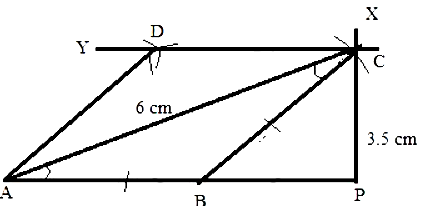
Construct a rhombus $\text{ABCD},$ when: Diagonal $AC = 6.0 \ cm$ and height $= 3.5 \ cm.$

Answer


Steps:
$1.$ draw a line$ AP.$
$2.$ now draw $A C=6\ cm$ and $C P=3.5\ cm$.
$3.$ Now draw a line $B C$ such that $A B=B C$.
$4.$ Now at $C$ draw a line $C Y$ parallel to $AP.$
$5.$ At point $C$ and $A$, taking radius same as $A B$ draw arcs cutting each other at $D.$
$6.$ Now join $AD.$
$\text{ABCD}$ is the required rhombus.

Need a full question paper?

Generate a complete, print-ready paper with questions like this in minutes — across 16+ boards, with answer keys.
Start Generating Free

Similar questions

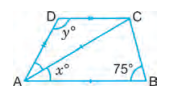
In the given figure, AC is the bisector of $\angle A$. If $AB = AC$, $AD = CD$ and $\angle ABC =75^{\circ}$, find the values of $x$ and $y$.
Image
In the given figure, $\angle QPR = 50^\circ $ and $\angle PQR = 60^\circ $. Show that: $SN < SR$
​​​​​​​
If $a+\frac{1}{a}=6$ and $a \neq 0$ find:$(i) a-\frac{1}{a};(ii) a^2-\frac{1}{a^2}$
The consecutive angles of a parallelogram are in the ratio $3:6$. Calculate the measures of all the angles of the parallelogram.
A boy is now one$-$third as old as his father. Twelve years hence he will be half as old as his father. Determine the present ages of the boy and that of his father.
If $1960=2^a \times 5^b \times 7^c$, find the values of $a, b, c$.
Hence, calculate the value of $\left(2^{-a} \times 5^{-c} \times 7^b\right)$.
The diagonals of a quadrilateral intersect each other at right angle. Prove that the figure obtained by joining the mid$-$points of the adjacent sides of the quadrilateral is a rectangle.
The value of a machine, purchased two years ago, depreciates at the annual rate of $10\%$. If its present value is $Rs.97,200$, find:
  1. Its value after 2 years.
  2. Its value when it was purchased.
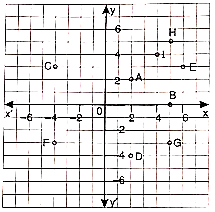
Use the graph given alongside, to find the coordinates of the point $(s)$ satisfying the given condition:$(i)$ The abscissa is $2.(ii)$The ordinate is $0.(iii)$ The ordinate is $3.(iv)$ The ordinate is $-4.(v)$ The abscissa is $5.(vi)$ The abscissa is equal to the ordinate.$(vii)$ The ordinate is half of the abscissa.
Write the logarithmic equation for:$V =\frac{1}{ D l} \sqrt{\frac{ T }{\pi r }}$