Question
Construct a rhombus with side $6\ cm$ and one diagonal $8\ cm$. Measure the other diagonal.
Answer


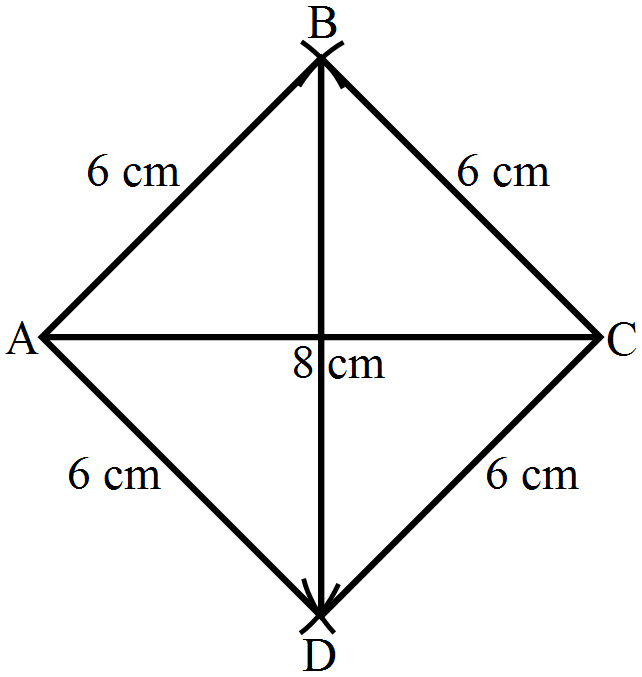
Steps of construction:
Step $1$: Draw $AC = 8\ cm$.
Step $2$​​​​​​​: With $A$ as the centre and radius $= 6\  cm$, draw arcs on both sides.
Step $3$: With $C$ as the centre and radius $= 6\ cm$, draw arcs on both sides, intersecting the previous arcs at points $B$ and $D$.
Step $4$​​​​​​​: Join $BD = 8.9\ cm$. Thus, $ABCD$ is the required rhombus.

Need a full question paper?

Generate a complete, print-ready paper with questions like this in minutes — across 16+ boards, with answer keys.

Start Generating Free

Similar questions

Sarita buys goods worth $Rs. 5,500$. She gets a rebate of $5\%$ on it. After getting the rebate if $VAT$ at the rate of $5\%$ is charged, find the amount she will have to pay for the goods.
Solve:
$4y^2+ 12y + 5$
Represent the following numbers in the Egyptian system : 10458, 1023, 2660, 784, 1111, 70707.
$A, B$ and $C$ can do a piece of work in $15, 12$ and $20$ days respectively. They started the work together, but $C$ left after $2$ days. In how many days will the remaining work be completed by $A$ and $B?$
It $x$ and $y$ vary inversely, fill in the following blanks:
$x$
$9$ $...$
$81$
$243$
$y$
$27$ $9$
$...$
$1$
The height of a right circular cylinder is $10. 5\ m$. Three times the sum of the areas of its two circular faces is twice the area of the curved surface. Find the volume of the cylinder.
Find the area of the following regular hexagon.
On a particular day, the sales (in rupees) of different items of a baker’s shop are given below.
ordinary bread $320$
fruit bread $80$
cakes and pastries $160$
biscuits $120$
others $40$
Total $720$
Draw a pie chart for this data
Draw a graph for the radius and circumference of circle using a suitable scale.
[Hints Take radius = 7,14 and 21 units and so on]
From the graph,
(i) Find the circumference of the circle when radius is 42 units.
(ii) At what radius will the circumference of the circle be 220 units?
Verify associativity of addition of rational numbers i.e., $(x + y) + z = x + (y + z)$, when: $\text{x}=\frac{-7}{11},\text{y}=\frac{2}{-5},\text{z}=\frac{-3}{22}$