Question
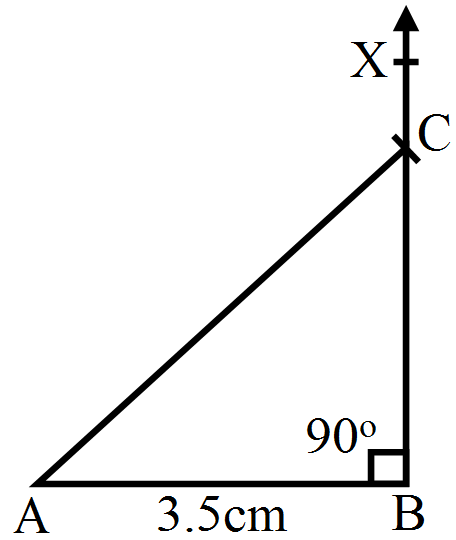
Construct a right-angled triangle one side of which measures $3.5\ cm$ and the length of whose hypotenuse is $6\ cm.$
Answer

Steps for construction: Step I: Draw $AB = 3.5\ cm$
Step II: Construct $\angle\text{ABX}=90^\circ$
Step III: With centre $A$, draw an arc of radius $6 \ cm$ cutting $BX$ at $C.$​​​​​​​
Step IV: Join $AC$. Then, $ABC$ is the required triangle.

Need a full question paper?

Generate a complete, print-ready paper with questions like this in minutes — across 16+ boards, with answer keys.

Start Generating Free

Similar questions

Is it necessary to construct the pairs of arcs above and below XY? Instead, can we construct both pairs of arcs on the same side of XY? Explore this through construction, and then justify your answer.
$1200$ soldiers in a fort had enough food for $28$ days. After $4$ days, some soldiers were transferred to another fort and thus the food lasted for an extra $32$ days. How many soldiers left the fort?
Find the following products:
(a) 4 × (-3)
(b) (-6) × (-3)
(c) (-5) × (-1)
(d) (-8) × 4
(e) (-9) × 10
(f) 10 × (-17)
The value of the expression $(10 y-20)$ depends on the value of $y$. Verify this by giving five different values to $y$ and finding for each $y$ the value of $(10 y-20)$. From the different values of $(10 y-20)$ you obtain, do you see a solution to $10 y-20=50$ ?
If there is no solution, try giving more values to $y$ and find whether the condition $10 y-20=50$ is met.
Two coins are tossed simultaneously $500$ times and the outcomes are noted as given below:
Outcome:
Two heads $(HH)$
One head $(HT$ or $TH)$
No head $(TT)$
Frequency:
$105$
$275$
$120$
If same pair of coins is tossed at random, find the probability of getting:
$i.$ Two heads
$ii.$ One head
$iii.$ No head
Assume $x$ and $y$ are two negative numbers. The result of the multiplication of $x$ and $y$ with the same positive power is greater than the multiplication of $x$ and $y$ with the same negative power. Give an example to support this statement.
Select those rational numbers which can be written as a rational number with numerator 6: $\frac{1}{22}, \frac{2}{3}, \frac{3}{4}, \frac{4}{-5}, \frac{5}{6}, \frac{-6}{7}, \frac{-7}{8}$
The length of a rectangular plot of area $65 \frac{1}{3} m^2$ is $12 \frac{1}{4} m$. What is the width of the plot?
If $x : y = 3 : 4$, find $(3x + 4y) : (5x + 6y).$
When constructing the perpendicular bisector, is it necessary to have the same radius for the arcs above and below XY? Explore this through construction, and then justify your answer.
[Hint 1: Any point that is of the same distance from X and Y lies on the perpendicular bisector.
Hint 2: We can draw the whole line if any two of its points are known.]