Question
Construct a trapezium $\text{ABCD}$ where $\ce{AB \| CD, AD = BC = 3.2\ cm, AB = 6.4\ cm}$ and $\ce{CD = 9.6\ cm}$.
Measure $\angle\text{B}\ \text{and}\ \angle\text{A}.$
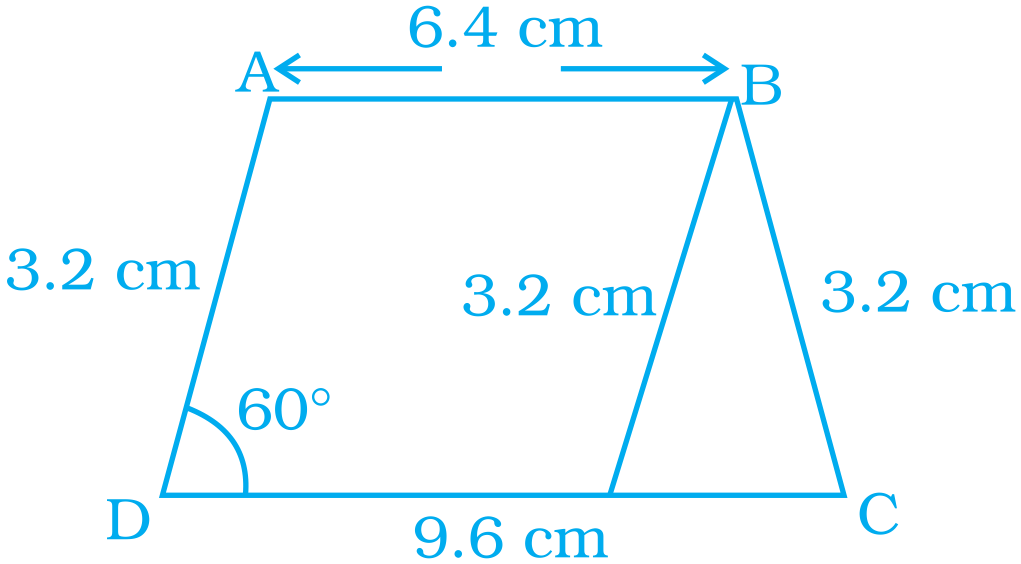
$[$Hint: Difference of two parallel sides gives an equilateral triangle.$]$
Answer


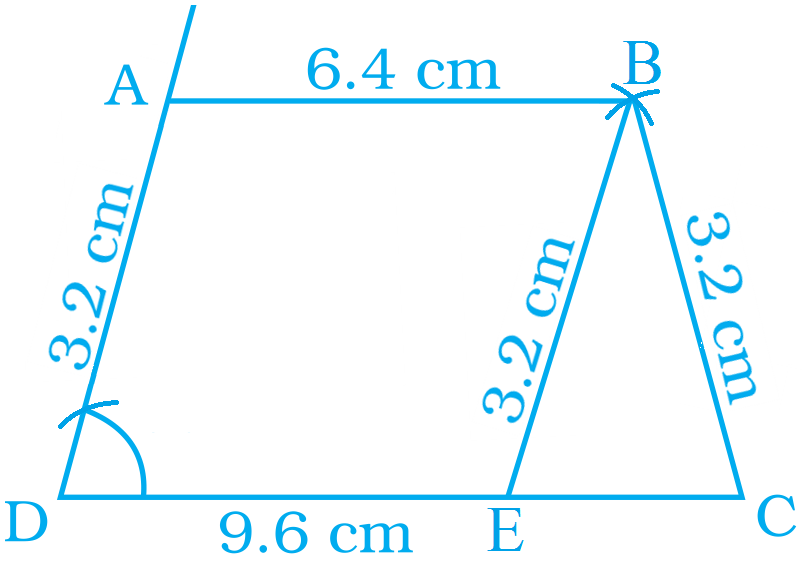
Steps of construction:
$1.$ Draw a line segment $\text{DC} = 9.6\ cm$.
$2.$ With $D$ as centre, draw an angle measure $60^\circ$.
Now, cut$-$off it with an arc $3.2\ cm$ called point $A$.
$3.$ Now draw a parallel $\text{AB}$ to $\text{CD}$.
$4.$ Taking $C$ as centre, cut an arc $B$ measure $3.2\ cm$ on previous parallel line.
$5.$ Draw a line segment $\text{BE} = 3.2\ cm$ from arc $B$.
$6.$ Join $B$ to $E$ and $C$.
Thus, we have required trapezium $\text{ABCD}$ in which $\angle\text{A}=120^\circ$ and $\angle\text{B}=60^\circ.$

Need a full question paper?

Generate a complete, print-ready paper with questions like this in minutes — across 16+ boards, with answer keys.

Start Generating Free

Similar questions

Verify whether the given statement is true or false: $\Big\{(-16)\div\frac{6}{5}\Big\}\div\frac{-9}{10}=(-16)\div\Big\{\frac{6}{5}\div\frac{-9}{10}\Big\}$
A cistern can be filled by a tap in $4$ hours and emptied by an outlet pipe in $6$ hours. How long will it take to fill the cistern if both the tap and the pipe are opened together?
The ages of sonu and Monu are in the ratio $7 : 5$. Ten years hence, the ratio of their ages will be $9 : 7$. Find their present ages.
Solve $13(y-4)-4(y-6)+5(y-9)=0$
Find the area of given figure $ABCDEFGH$ as per dimensions given in it.
Find the area of the field shown in Fig. by dividing it into a square, a rectangle and a trapezium.
$PQRSTU$ is a regular hexagon. Determine each angle of $\triangle\text{PQT}$.
Divide $24\left(x^2 y z+x y^2 z+x y z^2\right)$ by 8xyz using both the methods.
Express product as a monomials and verify the result in each case for $x = 1: (5x^4) × (x^2)^3× (2x)^2$
Draw a parallelogram $ABCD$ on a graph paper with the coordinates given in Table $I.$ Use this table to complete Tables $II$ and $III$ to get the coordinates of $E, F, G, H$ and $J, K, L, M$.
Table $I$
point
$(x, y)$
$A$
$(1, 1)$
$B$
$(4, 4)$
$C$
$(8, 4)$
$D$
$(5, 1)$
Table $II$
point
$(0.5x, 0.5y)$
$E$
$(0.5, 0.5)$
$F$
 
$G$
 
$H$
 
Table $III$
point
$(2x, 1.5y)$
$J$
$(2, 1.5)$
$K$
 
$L$
 
$M$
 
Draw parallelograms $EFGH$ and $JKLM$ on the same graph paper. Plot the points $(2, 4)$ and $(4, 2)$ on a graph paper, then draw a line segment joining these two points.