Given: In triangle ABC, AB = 4.2 cm, BC = 6.3 cm and AC = 5 cm
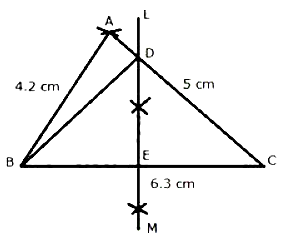
Steps of Construction: i) Draw a line segment BC = 6.3 cm
ii) With centre B and radius 4.2 cm, draw an arc.
iii) With centre C and radius 5 cm, draw another arc which intersects the first arc at A.
iv) Join AB and AC. ΔABC is the required triangle.
v) Again with centre B and C and radius greater than 12 BC, draw arcs which intersects each other at L and M.
vi) Join LM intersecting AC at D and BC at E.
vii) Join DB. Proof: In ΔDBE and ΔDCE BE = EC (LM is bisector of BC) ∠DEB = ∠DEC (Each = 90°) DE = DE (Common)
∴ By side angle side criterion of congruence, we have ΔDBE ≅ ΔDCE (SAS postulate)
The corresponding parts of the congruent triangle are congruent
∴ DB = DC (CPCT) Hence, D is equidistant from B and C.