Question

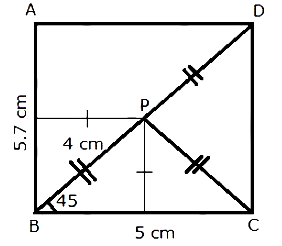
Construct a triangle BPC given BC = 5 cm, BP = 4 cm and .

i) complete the rectangle ABCD such that:
a) P is equidistant from AB and BCV
b) P is equidistant from C and D.
ii) Measure and record the length of AB.
Answer


1. i) Steps of Construction:
1) Draw a line segment BC = 5 cm
2) B as centre and radius 4 cm draw an arc at an angle of 45 degrees from BC.
3) Join PC.
4) B and C as centers, draw two perpendiculars to BC.
5) P as centre and radius PC, cut an arc on the perpendicular on C at D.
6) D as centre, draw a line parallel to BC which intersects the perpendicular on B at A.
ABCD is the required rectangle such that P is equidistant from AB and BC (since BD is angle bisector of angle B) as well as C and D.
5. ii) On measuring AB = 5.7 cm

Need a full question paper?

Generate a complete, print-ready paper with questions like this in minutes — across 16+ boards, with answer keys.
Start Generating Free

Similar questions

Using ruler and compasses only, draw an equilateral triangle of side 5 cm, draw its inscribed circle. Measure the radius of the circle.
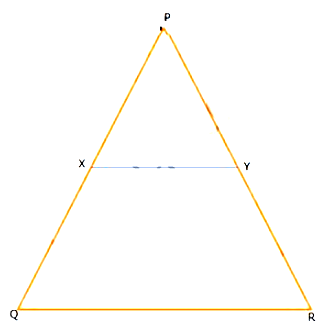
The following figure shows a triangle PQR in which XY is parallel to QR. If $PX : XQ = 1 : 3$ and $QR = 9$ cm. find the length of XY.

Further, if the area of $\triangle PXY =x cm^2$; find, in terms of x the area of:
(i) triangle PQR (ii) trapezium XQRY
Calculate the mean of the distribution given below using the short cut method.
 
Marks 11 - 20 21 - 30 31 - 40 41 - 50 51 - 60 61 - 70 71 - 80
No. of students 2 6 10 12 9 7 4
Prove the following identity:
$
2\left(\sin ^6 \theta+\cos ^6 \theta\right)-3\left(\sin ^4 \theta+\cos ^4 \theta\right)+1=0
$
If the speed of a car is increased by $10\ km$ per hr, it takes $18$ minutes less to cover a distance of $36\ km.$ Find the speed of the car.
If $(x-2)$ is a factor of $2 x^3-x^2-p x-2$,
(a) find the value of $p$.
(b) with the value of $p$, factorise the above expression completely.
If $A=\left[\begin{array}{cc}2 & -1 \\ -4 & 5\end{array}\right]$ and $B=\left[\begin{array}{c}-3 \\ 2\end{array}\right]$ find the matrix $C$ such that $A C=B$
From a solid cylinder whose height is $2.4 \ cm,$ and diameter $1.4 \ cm,$ a conical cavity of the same height and same diameter is hollowed out. Find the total surface area of the remaining solid to the nearest $\ cm^{2.}$​​​​​​​
A sphere has the same curved surface area as the curved surface area of a cone of height 36 cm and base radius 15 cm . Find the radius of the sphere .
In triangle $ABC,$ the co-ordinates of vertices $A, B$ and $C$ are $(4, 7), (-2, 3)$ and $(0, 1)$ respectively.
Find the equation of median through vertex $A.$
Also, find the equation of the line through vertex $B$ and parallel to $AC.$