Question
Construct a triangle using the given data: $BC = 6.0\ cm, \angle B = 60^\circ $ and $\angle C = 45^\circ $

Answer

$BC = 6.0\ cm, \angle B = 60^\circ $ and $\angle C = 45^\circ $

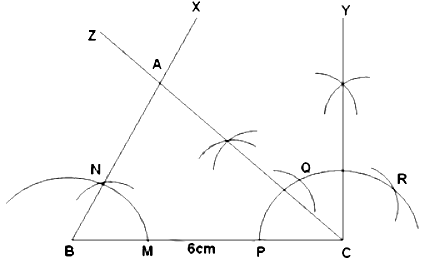
Steps of Construction:
$1$. Draw a line segment $BC = 6\ cm.$
$2$. With $B$ as centre, draw an arc meeting $BC$ at $M.$
$3$. With M as centre and same radius, cut the arc at $N.$
$4$. Produce $BN$ to $BX. BX$ makes an angle of $60^\circ $ with $BC.$
$5$. With $C$ as centre, draw an arc meeting $BC$ at $P.$
$6$. With $P$ as centre and same radius, cut the arc at $Q$ and with $Q$ as centre and same radius, cut the arc at $R.$
$7.$ With $Q$ and $R$ as centre, cut arcs and draw $CY$ perpendicular to $BC.$
$8$. Bisect $\angle YCB$. Let $CZ$ be the bisector. $CZ$ makes an angle of $45^\circ $ with $BC.$
$9$. Mark the point as $A$, where $CZ$ and $BX$ cut each other.
Thus, $\text{ABC}$ is the required triangle.

Need a full question paper?

Generate a complete, print-ready paper with questions like this in minutes — across 16+ boards, with answer keys.
Start Generating Free

Similar questions

A man borrows $Rs.5,000$ at $12$ percent compound interest payable every six months. He repays $Rs.1,800$ at the end of every six months. Calculate the third payment he has to make at the end of $18$ months in order to clear the entire loan.
Calculate $x$ :
A sum of $Rs. 44,200$ is divided between John and Smith, $12$ years and $14$ years old respectively, in such a way that if their portions be invested at $10\%$ per annum compound interest, they will receive equal amounts on reaching $16$ years of age.
$(i)$What is the share of each out of $Rs.44,200$ ?
$(ii)$ What will each receive, when $16.years$ old ?
The class marks of a frequency distribution are $: 15, 25, 35, 45, 55, 65$ and $75.$ Determine the class limits.
Sum of the areas of two squares is $400 \sim cm^2$. If the difference of their perimeters is $16 \ cm$, find the sides of the two squares. 
Image
Case Study : Rajbeer is a farmer. He has a plot of land in the shape of a quadrilateral ABCD as shown in the figure. In $A B C D, A B \| C D$ and $A D \| B C$. He divided the field into two parts, viz, triangle BCE and trapezium CDAE by making an embankment CE such that $CE = AD$.
Based on the above information, answer the following questions :
1. ABCD is a :
(a) Rectangle
(b) Parallelogram
(c) Square
(d) Trapezium
2. $\angle A$ is equal to:
(a) $\angle D$
(b) $\angle B$
(c) $\angle C$
(d) $\angle E$
3. $\angle DCE$ is equal to:
(a) $\angle E$
(b) $\angle A$
(c) $\angle D$
(d) $\angle B$
4. Which of the following is correct?
(a) $\triangle AEC \cong \triangle EAD$
(b) $\triangle ACE \cong \triangle AED$
(c) $\triangle CEA \cong \triangle EAD$
(d) none of these
5. Diagonal DE is equal to:
(a) diagonal DB
(b) diagonal AC
(c) DC
(d) BC
In $\text{DPQR}$ as shown, $\angle PQS = \angle RQ$S and $QS \perp PR$. Find the value of $x$ and $y$, if $PQ = 3x + 1; QR = 5y - 2; PS = x + 1$ and $SR = y + 2.$
Solve the following system of equations graphically$:\ x - y + 1 = 0;4x + 3y = 24$
Evaluate the following:$\left(\frac{64}{216}\right)^{\frac{2}{3}} \times\left(\frac{16}{36}\right)^{-\frac{3}{2}}$
Simple interest on a sum of money for $2$ years at $4\%$ is $Rs. 450$. Find the compound interest at the same rate for $1$ year if the interest is reckoned half$-$yearly.