Question
Construct a triangle with sides $5 cm, 4 cm$ and 6 cm . Then construct another triangle whose sides are $\frac{2}{3}$ times the corresponding sides of first triangle.
Answer

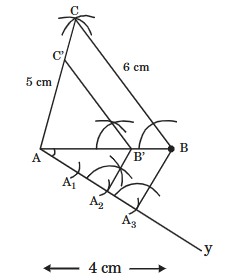
Following are the steps of constructing a required triangle.
Step 1: Draw a line segment $A B=4 cm$ and then draw an are of radius 5 cm considering $A$ as a center.
Step 2: Draw an arc of radius 6 cm considering $B$ as center.
Step 3: Name the point where both the ares from step 1 and step 2 intersect as $C$.
Step 4: Join $B C$ and $A C . \triangle A B C$ is formed.
Step 5: Draw a ray $A Y$ which forms an acute angle with $A B$ on the opposite side of the vertex $C[1 / 2]$ Step 6: Locate three points $A_1, A_2$, and $A_3$ on lines $A Y$ such that $A A 1=A_1 A_2=A_2 A_3$.
Step 7: Join $B$ and $A_3$.
Step 8: Draw a line segment from point $A_2$ and parallel to $B A_3$ which intersects $A B$ at point $B$ '.
Step 9: Draw a line segment from $B^{\prime}$ and parallel to $B C$ which intersects $A C$ at the point $C^{\prime}$. [1/2] Thus, required triangle $\triangle A B^{\prime} C^{\prime}$ whose sides are $\frac{2}{3}$ times the corresponding sides of first triangle ( $\triangle A B C$ ) has been constructed.
Image

Need a full question paper?

Generate a complete, print-ready paper with questions like this in minutes — across 16+ boards, with answer keys.
Start Generating Free

Similar questions

In a $\triangle\text{ABC,D}\ \text{and E}$ are points on the sides AB and AC respectively such that DE || BC.
If $\frac{\text{AD}}{\text{DB}}=\frac{2}{3}$ and AC = 18cm, find AE.
A bag contains 6 red, 8 black and 4 white balls. A ball is drawn at random. What is the probability that ball drawn is not black?
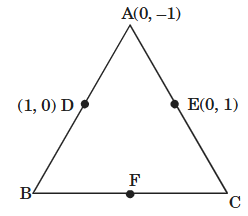
In the given figure, $\text{ABC}$ is a triangle coordinates of whose vertex $A$ are $(0,-1) D$ and E respectively are the mid $-$ points of the sides $A B$ and $A C$ and their coordinates are $(1,0)$ and $(0,1)$ respectively. If $F$ is the mid $-$ point of $B C$, find the areas of $\triangle A B C$ and $\triangle D E F$.
Image
A cone of height $24 \ cm$ and radius of base $6 \ cm$ is made up of modelling clay. A child reshapes it in the form of a sphere. Find the radius of the sphere and hence find the surface area of this sphere.
Prove the following:$\frac{\cos(90^\circ-\text{A})\sin(90^\circ-\text{A})}{\tan(90^\circ-\text{A})}-\sin^2\text{A}=0$
It is given that $\triangle\text{ABC}\sim\triangle\text{EDF}$ such that AB = 5cm, AC = 7cm, DF= 15cm and DE = 12cm. Find the lengths of the remaining sides of the triangles.
If $\cot\theta=\frac{1}{\sqrt{3}},$ write the value of $\frac{1-\cos^2\theta}{2-\sin^2\theta}.$
In the following, find the value of k for which the given value is a solution of the given equation:
$7\text{x}^2+\text{kx}-3=0,$ $\text{x}=\frac{2}{3}$
Five years ago, Nuri was thrice as old as Sonu. Ten years later, Nuri will be twice as old as Sonu. How old are Nuri and Sonu? Solve the pair of the linear equation obtained by the elimination method.
The $4^{\text {th }}$ term of an AP is zero. Prove that its $25^{\text {th }}$ term is triple its $11^{\text {th }}$ term.