Question
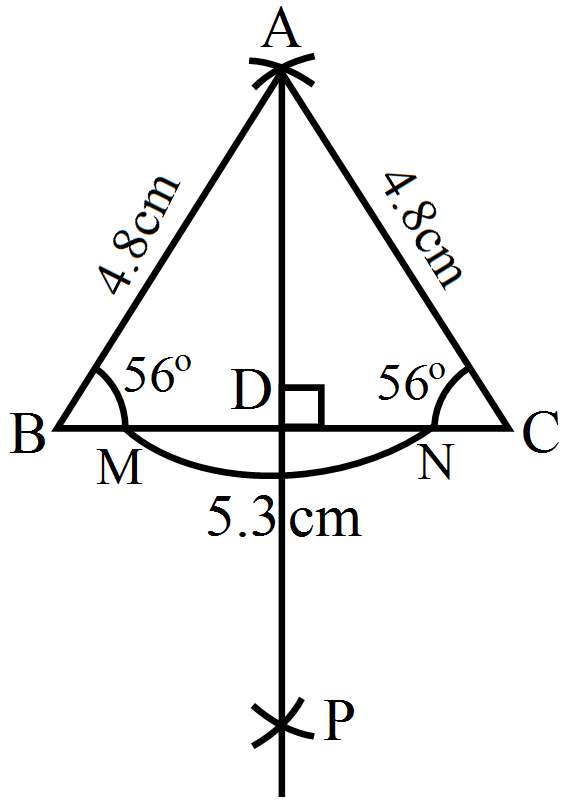
Construct a $\triangle\text{ABC}$ in which $AB = AC = 4.8\ cm$ and $BC = 5.3\ cm$. Measure $\angle\text{B}$ and $\angle\text{C}$. Draw $\text{AD}\bot\text{BC}$.
Answer

Steps for construction:
Step I: Draw $BC = 5.3cm$
Step II: Draw an arc of radius $4.8cm$ from the centre, $B.$​​​​​​​
Step III: Draw another arc of radius $4.8cm$ from the centre, $C.$​​​​​​​
Step IV: Both of these arcs intersect at $A$.
Step V: Join $AB$ and $AC.$​​​​​​​
Step VI: With $A$ as the centre and any radius, draw an arc cutting $BC$ at $M$ and $N.$​​​​​​​
Step VII: With $M$ as the centre and the radius more than half of $MN$, draw an arc.
Step VIII: With $N$ as the centre and the same radius, draw another arc cutting the previously drawn arc at $P$.
Step IX: Join $AP$, cutting $BC$ at $D$.Then, $\text{AD}\bot\text{BC}$

Need a full question paper?

Generate a complete, print-ready paper with questions like this in minutes — across 16+ boards, with answer keys.

Start Generating Free

Similar questions

$14=\frac{7\text{x}}{10}-8$
Case-Based Question :
Rita is organising a school fair. She is in charge of budgeting for various stalls. She notes the following expenses :
→ The cost of each food stall is ₹ x.
→ The cost of each game stall is ₹ y.
→ She plans to have 4 food stalls and 3 game stalls.
There is a fixed decoration cost of ₹ 500.
Based on the above information, answer the following questions.
(a) Write an expression for the total cost to organise the school fair.
(b) What does the term 4x represent?
(c) If the cost of each food stall is ₹200 and each game stall is ₹ 150, what will be the total cost?
If  ₹250 is to be divided amongst Ravi, Raju and Roy, so that Ravi gets two parts, Raju three parts and Roy five parts. How much money will each get? What will it be in percentages?
On a particular day in a school, the attendance in each of the classes from $VI$ to $X$ has been recorded as under.
Class
$VI$
$VII$
$VIII$
$IX$
$X$
Total no. of students
$95$
$90$
$82$
$75$
$68$
Number of students present on that day
$92$
$85$
$78$
$69$
$62$
Draw a double bar graph, choosing an appropriate scale.
Using the bar graph, answer the questions given below:
$i.$ Which class has the maximum number of students?
$ii.$ Find the ratio of number of students present to the total number of students in Class $VII.$
$iii.$ What per cent of Class $IX$ students were absent?
Take the data giving the minimum and the maximum temperature of various cities given in Table. Plot a double bar graph using the data and answer the question: Which is the hottest city and which is the coldest city?
Temperatures of Cities as on $20.6.2006$
City Max. Min.
Ahmedabad $38^{\circ} \mathrm{C}$ $29^{\circ} \mathrm{C}$
Amritsar $37^{\circ} \mathrm{C}$ $26^{\circ} \mathrm{C}$
Banglore $28^{\circ} \mathrm{C}$ $21^{\circ} \mathrm{C}$
Chennai $36^{\circ} \mathrm{C}$ $27^{\circ} \mathrm{C}$
Delhi $38^{\circ} \mathrm{C}$ $28^{\circ} \mathrm{C}$
Jaipur $39^{\circ} \mathrm{C}$ $28^{\circ} \mathrm{C}$
Jammu $41^{\circ} \mathrm{C}$ $26^{\circ} \mathrm{C}$
Mumbai $32^{\circ} \mathrm{C}$ $27^{\circ} \mathrm{C}$
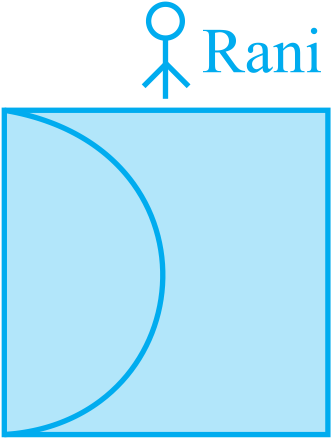
Rani bought a new field that is next to one she already owns Fig. This field is in the shape of a square of side $70\ m$. She makes a semi circular lawn of maximum area in this field.
$i.$ Find the perimeter of the lawn.
$ii.$ Find the area of the square field excluding the lawn.
The table below compares the population $($in hundreds$)$ of $4$ towns over two years:
Towns
$A$ $B$ $C$ $D$
$2007$
$2900$
$6400$
$8300$
$4600$
$2009$
$3200$
$7500$
$9200$
$6300$
Study the table and answer the following questions:
$a.$ Draw a double bar graph using appropriate scale to depict the above information.
$b.$ In which town was the population growth maximum?
$c.$ In which town was the population growth least?
$\frac{\text{x}}{2}+\frac32=\frac{2\text{x}}{5}-1$
Find the area of a rhombus each side of which measures $20\ cm$ and one of whose diagoanls is $24\ cm.$
The following table shows the weight of $12$ players:
Weight (in kg) $48$ $50$ $52$ $54$ $58$
Number of players $4$ $3$ $2$ $2$ $1$
Find the median and mean weights.
Using empirical formula, calculate its mode.