Question
Construct △ ABC such that AB + BC + CA = 11.3 cm, ∠B = 70°, ∠C = 60°.

Answer

Get the step-by-step solution for this question inside the Vidyadip app.

Get the answer in the app

Need a full question paper?

Generate a complete, print-ready paper with questions like this in minutes — across 16+ boards, with answer keys.
Start Generating Free

Similar questions

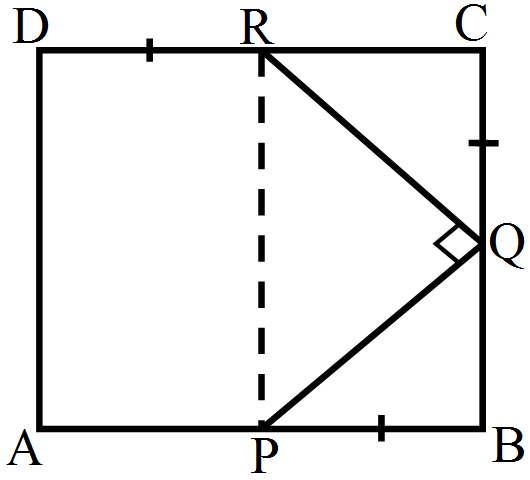
In the given figure, ABCD is a square and $\angle\text{PQR}=90^{\circ}.$ If PB = QC = DR, prove that:
  1. QB = RC,
  2. PQ = QR,
  3. $\angle\text{QPR}=45^{\circ}$
A chord of length $30\ cm$ is drawn at a distance of $8\ cm$ from the centre of a circle.
Find out the radius of the circle.
The monthly maximum temperature of a city is given in degree Celsius in the following data. By taking suitable classes, prepare the grouped frequency distribution table
29.2, 29.0, 28.1, 28.5, 32.9, 29.2, 34.2, 36.8, 32.0, 31.0, 30.5, 30.0, 33, 32.5, 35.5, 34.0, 32.9, 31.5, 30.3, 31.4, 30.3, 34.7, 35.0, 32.5, 33.5.29.0. 29.5.29.9.33.2.30.2
From the table, answer the following questions.
i. For how many days the maximum temperature was less than 34°C?
ii. For how many days the maximum temperature was 34°C or more than 34°C?
The diagonals of a quadrilateral ABCD are equal. Prove that the quadrilateral formed by joining the midpoints of its sides is a rhombus.
Solve the following equations : $\frac{10 x^2+15 x+63}{5 x^2-25 x+12}=\frac{2 x+3}{x-5}$
A point D is taken on the side BC of a $\triangle\text{ABC},$ such that BD = 2DC. Prove that $\text{ar}(\triangle\text{ABD})=2\text{ar}(\triangle\text{ADC}).$
Find the length of a chord which is at a distance of 3cm from the centre of a circle of radius $5\ cm$.
On a graph paper, plot the points A(2, 3), B(6, -1) and C(0, 5). If these points are collinear, then draw the line which includes them. Write the co-ordinates of the points at which the line intersects the X-axis and the Y-axis.
Find the values of a and b so that the polynomial $(x^4 + ax^3 - 7x^2- 8x + b)$ is exactly divisible by $(x + 2)$ as well as $(x + 3).$
If two straight lines intersect in such a way that one of the angles formed measures 90°, show that each of the remaining angles measures 90°.