Question
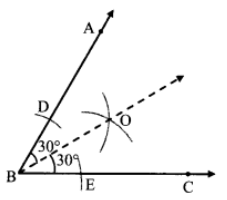
Construct an angle bisector to obtain an angle of 30°.

Answer

In order to get a bisected angle of a given measure, the student has to draw the angle having twice the measurement of required bisected angle.
For getting measurement of 30° (for the bisected angle), one has to make an angle of 60° (i.e. 30° × 2).

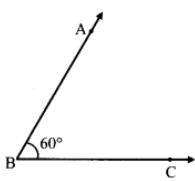
Step 1:
Draw $\angle ABC$ of $60^{\circ}$.
Image

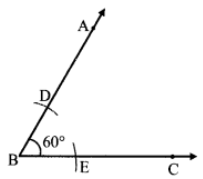
Step 2:
Cut arcs on the rays BA and BC. Name these points as D and E respectively.
Image

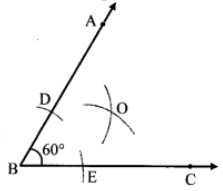
Step 3:
Place the compass point on point D and draw an arc inside the angle.
Without changing the distance of the compass, place the compass point on point E and cut the previous arc. Name the point of intersection as O
Image

Step 4:
Draw ray BO.
Ray $BO$ is the angle bisector of $\angle ABC$.
i.e. $m \angle A B O=m \angle C B O=30^{\circ}$
Image

Need a full question paper?

Generate a complete, print-ready paper with questions like this in minutes — across 16+ boards, with answer keys.
Start Generating Free

Similar questions

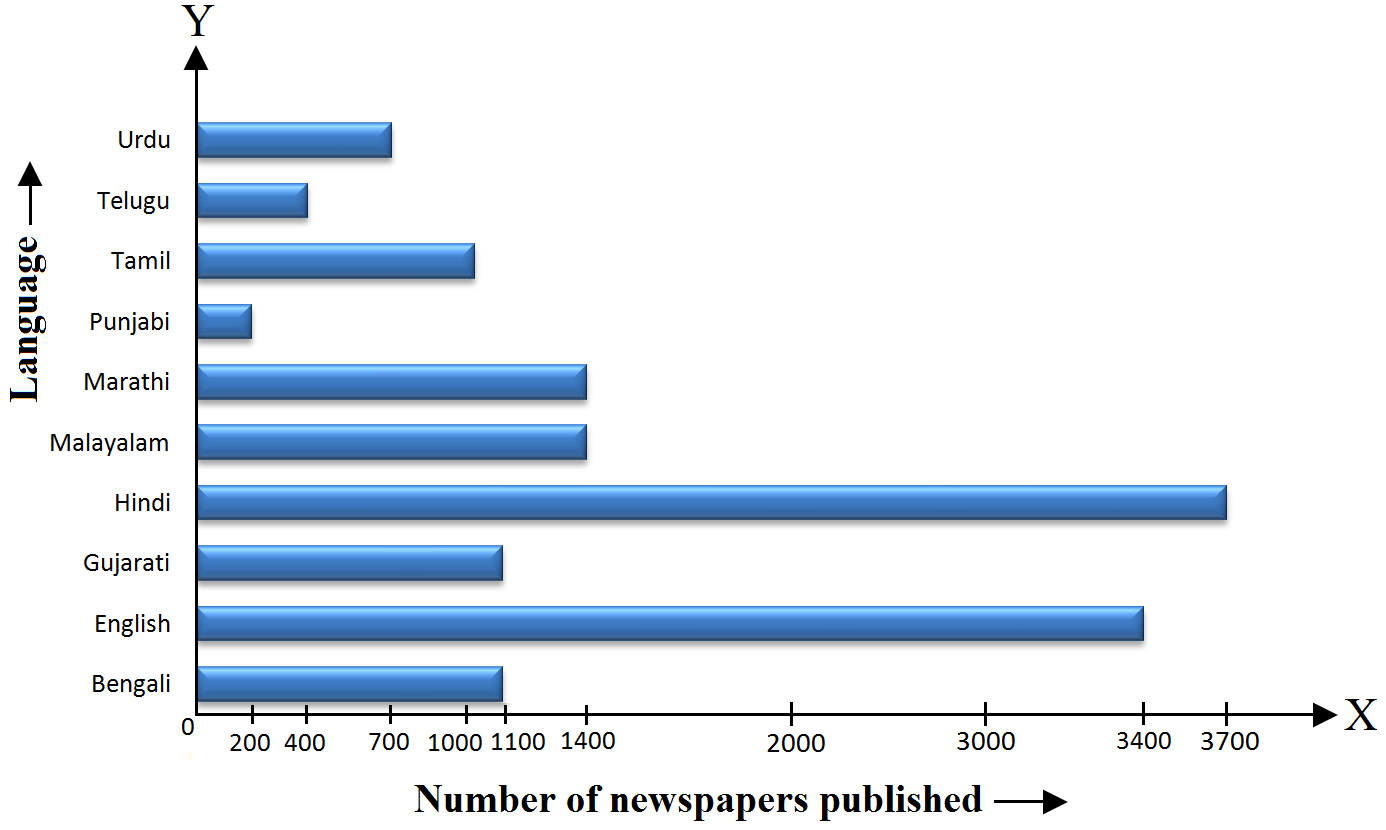
The bar graph shown in represents the circulation of newspapers in 10 languages. Study the graph and answer the following questions:
  1. What is the total number of newspapers published in Hindi, English, Urdu, Punjabi, and Bengali?
  2. What percent is the number of newspapers published in Hindi of the total number of newspapers?
  3. Find the excess of the number of newspapers published in English over those published in Urdu.
  4. Name two pairs of languages which publish the same number of newspapers.
  5. State the language, in which the smallest number of newspapers is published,
  6. State the language in which the largest number of newspapers is published.
  7. State the language in which the number of newspapers published is between 2500 and 3500.
  8. State whether true or false:
  1. The number of newspapers published in Malayalam and Marathi together is less than those published in English.
  2. The number of newspapers published in Telugu is more than those published in Tamil.
Match the equivalent fractions and write another 2 for each:
(i) $\frac{250}{400}$ (a) $\frac{2}{3}$
(ii) $\frac{180}{200}$ (b) $\frac{2}{5}$
(iii) $\frac{660}{990}$ (c) $\frac{1}{2}$
(iv) $\frac{180}{360}$ (d) $\frac{5}{8}$
(v) $\frac{220}{550}$ (e) $\frac{9}{10}$
Determine the number nearest to 100000 but greater than 100000 which is exactly divisible by each of 8, 15 and 21.
Ravish's house is $\frac{9}{10}\text{km}$ from his school. He walked some distance and then took a bus for $\frac{1}{2}\text{km}$ up to the school. How far did he walk?
Complete the following table:
NumberSum of digits in the numberIs the sum divisible by 3?Is the given number divisible by 3?
636 + 3 = 9
87217XX
91
552
9336
4527
$7 \frac{1}{8}-6 \frac{1}{10}$
Draw a circle with centre at point O. Draw its two chords AB and CD such that AB is not parallel to CD. Draw the perpendicular bisectors of AB and CD. At what point do they intersect?
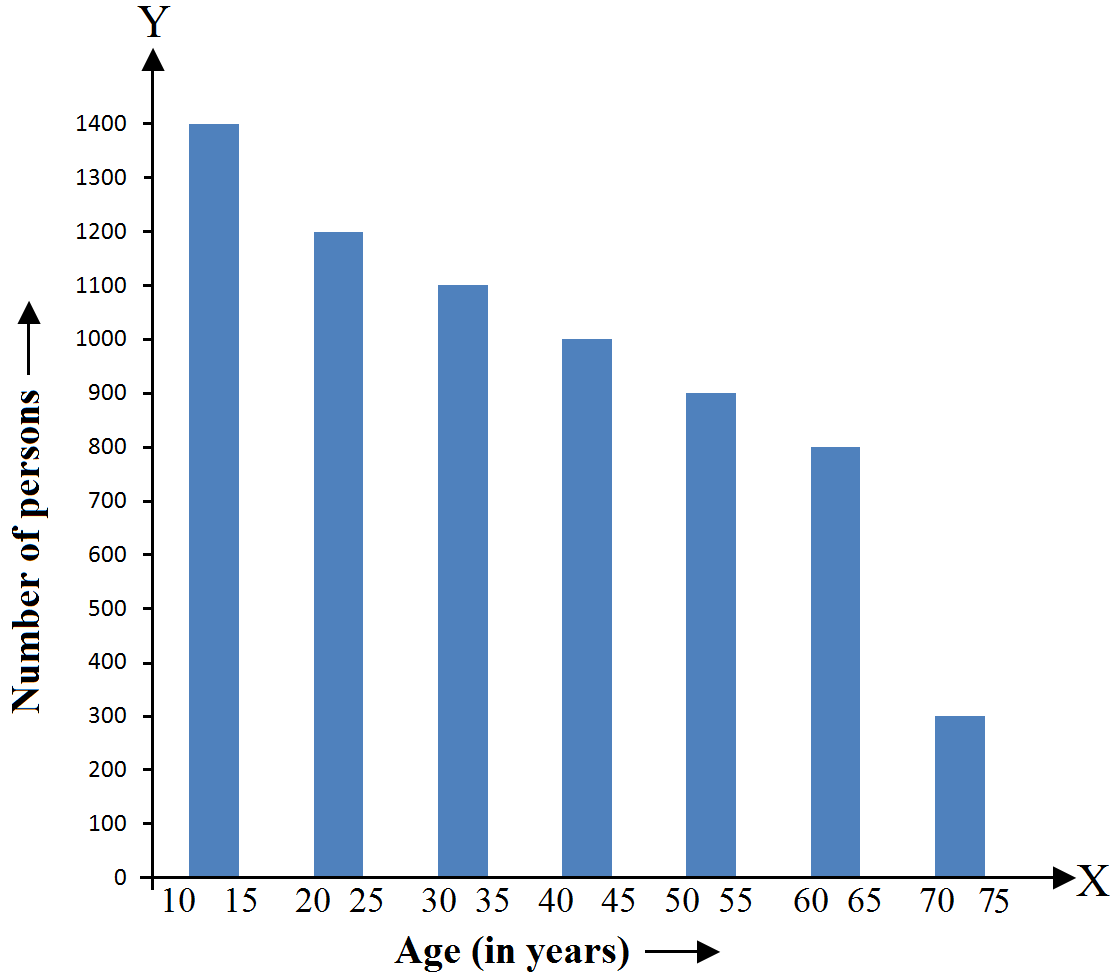
Study the bar graph representing the number of persons in various age groups in a town shown in Observe the bar graph and answer the following questions:
  1. What if the percentage of the youngest age-group persons over those in the oldest age group?
  2. What is the total population of the town?
  3. What is the number of persons in the age-group 60-65?
  4. How many persons are more in the age-group 10-15 than in the age group 30-35?
  5. What is the age-group of exactiy 1200 persons living in the town?
  6. What is the total number of persons living in the town in the age-group 50-55?
  7. What is the total muner of persons living in the town in the age-groups 10-15 and 60-65?
  8. Whether the population in general increases, decreases or remains constant with the increase in the age-group.
Match the following statements:
  Column A   Column B
i Line segment has a at a point
ii Two segments may intersect b if they have equal lengths
iii Two segments are congruent c two end-point
iv Line segment is d portion of a line
Find the largest number which divides 630 and 940 leaving remainders 6 and 4 respectively.