Question
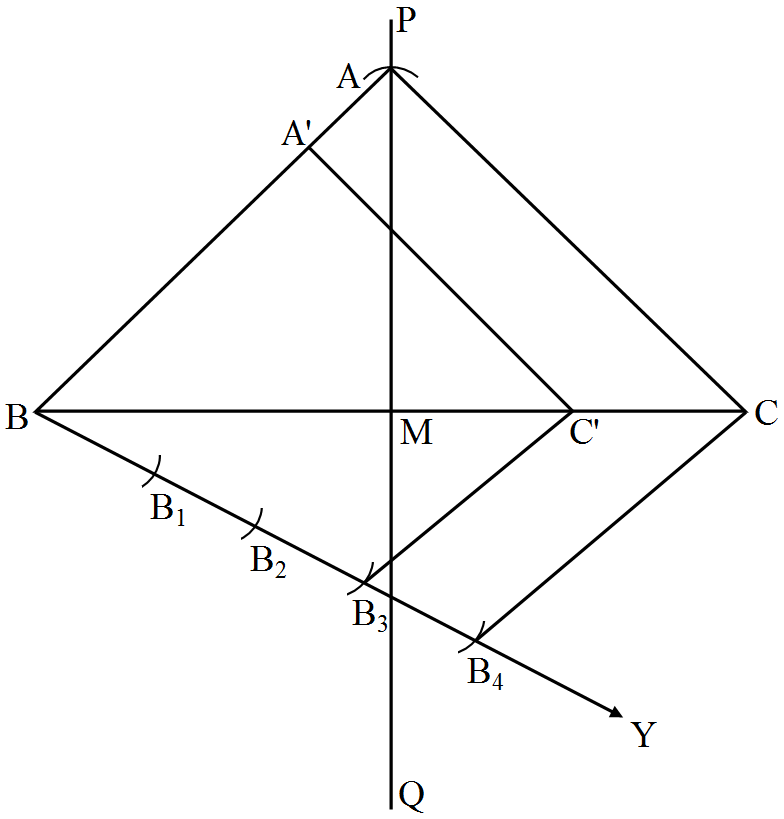
Construct an isosceles triangle whose base is $9\ cm$ and altitude $5\ cm$. Construct another triangle whose side are $\frac34$ of the corresponding sides of the first isosceles triangle.
Answer


Steps of construction:
1. Draw a line segment $B C=9 cm$
2. Draw peependicular bisector $P Q$ of $B C$ Meeting it at $M$.
3. Fron QP cut-off a distance $M A=5 cm$.
4. Join $A B$ and $A C$.
Thus, isosceles $\triangle ABC$ is obtained.
5. Below $B C$, make an acute $\angle C B X$.
6. Along BX , mark off 4 points $B_1, B_2, B_3, B_4$, such that $B B_1,=B_1 B_2=B_1 B_3=B_3 B_4$.
7. Join $B_4 C$
8. From $B_3$, draw $B_3 C^{\prime} \| B_4 C$, meeting BC at $C ^{\prime}$.
9. From $C^{\prime}$, draw $C^{\prime} A^{\prime} \| C A$, meeting $A B$ at $A^{\prime}$.
Thus, $\triangle A ^{\prime} BC ^{\prime}$ is the required triangle similar to $\triangle ABC$ Such that each side of $\triangle A ^{\prime} BC ^{\prime}$ is $\frac{3}{4}$ times the corresponding side of $\triangle ABC$.

Need a full question paper?

Generate a complete, print-ready paper with questions like this in minutes — across 16+ boards, with answer keys.

Start Generating Free

Similar questions

A bucket has top and bottom diameter of $40\ cm$ and $20\ cm$ respectively. Find the volume of the bucket if its depth is $12\ cm$. Also, find the cost of tin sheet used for making the bucket at the rate of $Rs. 1.20$ per $dm^2$. $(\text{use}\ \pi=3.14)$
Divide $29$ into two parts so that the sum of the squares of the parts is $425.$
If the $HCF$ of $408$ and $1032$ is expressible in the form $1032m - 408 \times 5$, find m.
Find the quadratic polynomial, sum of whose zeros is $8$ and their product is $12$. Hence, find the zeros of the polynomial.
Find the sum of first forty positive intergers divisible by $6.$
Find the number of metallic circular discs with $1.5\ cm$ base diameter and of height $0.2\ cm$ to be melted to form a right circular cylinder of height $10\ cm$ and diameter
$4.5\ cm.$
The sum of the first $7$ terms of an $AP$ is $182$. If its $4^{th}$ and $17^{th}$ terms are in the ratio $1 : 5,$ find the $AP.$
Find the roots of the following equations, if they exist, by applying the quadratic formula:
$\mathrm{x}^2-2 \mathrm{ax}-\left(4 \mathrm{~b}^2-\mathrm{a}^2\right)=0$
The median of the following data is $525.$ Find the missing frequency, if it is given that there are $100$ observations in the data:
Class interval Frequency
$0-100$ $2$
$100-200$ $5$
$200-300$ $f_1$
$300-400$ $12$
$400-500$ $17$
$500-600$ $20$
$600-700$ $f_2$
$700-800$ $9$
$800-900$ $7$
$900-1000$ $4$
The sum of the third and the seventh terms of an $AP$ is $6$ and their product is $8.$ Find the sum of the first sixteen terms of the $AP.$