Question
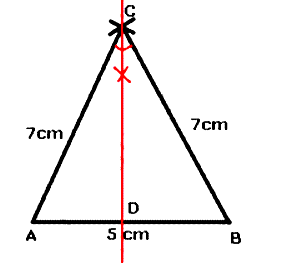
Construct an isosceles triangle whose equal sides are 7 cm each and the base side is 5 cm. Draw all its lines of symmetry.

Answer


Steps of construction:
>(i) Draw a line segment AB = 5 cm > >(ii) With A as centre, cut an arc of 7 cm on one side of line segment AB. > >(iii) With B as centre, cut an arc of 7 cm on same side of line segment AB. Let the point be C. > >(iv) Join AC and BC. ABC is the required triangle. > >(v) Draw angle bisector of angle C meeting AB at D. > >(vi) CD is perpendicular bisector of AB and AC=BC. Hence CD is the line of symmetry. > >Isosceles triangle has only one line of symmetry.

Need a full question paper?

Generate a complete, print-ready paper with questions like this in minutes — across 16+ boards, with answer keys.
Start Generating Free

Similar questions

Find the minimum length in $\ cm$ and correct to nearest whole number of the thin metal sheet required to make a hollow and closed cylindrical box of diameter $20 \ cm$ and height $ 35 \ cm.$ Given that the width of the metal sheet is $1 m.$ Also, find the cost of the sheet at the rate of $Rs. 56$ per $m.$ Find the area of metal sheet required, if $10\%$ of it is wasted in cutting, overlapping, etc.
A man invests a certain sum on buying 15% Rs.100 shares at 20% premium. Find :
(i) His income from one share
(ii) The number of shares bought to have an income, from the dividend, Rs.6480
(iii) Sum invested
Find the curved surface area , the total surface area and the volume of a cone if its :
Height = 15 cm , radius = 8 cm
Find the fourth proportion to the following:
$(p^2q - qr^2 ), (pqr - pr^2 )$ and $(pq^2 - pr^2)$
Prove that the perimeter of a right triangle is equal to the sum of the diameter of its incircle and twice the diameter of its circumcircle.
If $t_n$ represents $n ^{\text {th }}$ term of an A.P $t_2+t_5-t_3=10$ and $t_2+t_9=17$ Find its first term and its common difference.
The difference between the outer curved surface area and the inner curved surface area of a hollow cylinder is $352 cm^2$. If its height is $28 \ cm$ and the volume of material in it is $704 cm^3$; find its external curved surface area.
Draw a circle of radius 2. 5 cm and circumscribe a square about it.
Find the point on the x-axis equidistant from the points $(5,4)$ and $(-2,3).$
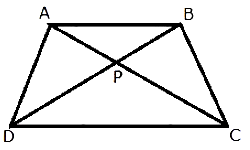
The given figure shows a trapezium in which AB is parallel to DC and diagonals AC and BD
intersect at point P. If AP : CP = 3: 5,

Find:
(1) ∆APB : ∆CPB (2 ) ∆DPC : ∆APB
(3) ∆ADP : ∆APB (iv) ∆APB : ∆ADB