Question
Construct ∆ABC, in which BC = 6.2 cm, ∠ACB = 50°, AB + AC = 9.8 cm.
Answer


Image

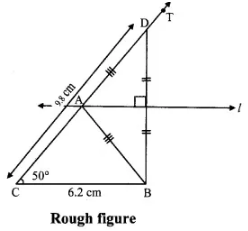
As shown in the rough figure draw seg CB = 6.2 cm
Draw a ray CT making an angle of 50° with CB
Take a point D on ray CT, such that
CD = 9.8 cm
Now, CA + AD = CD [C-A-D]
∴ CA + AD = 9.8 cm …….(i)
Also, AB + AC = 9.8 cm ……(ii) [Given]
∴ CA + AD = AB + AC [From (i) and (ii)]
∴ AD = AB
∴ Point A is on the perpendicular bisector of seg DB
∴ The point of intersection of ray CT and perpendicular bisector of seg DB is point A.

Steps of construction:
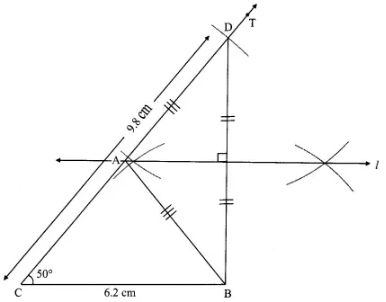
i. Draw seg BC of length 6.2 cm.
ii. Draw ray CT, such that ∠BCT = 50°.
iii. Mark point D on ray CT such that l(CD) = 9.8 cm.
iv. Join points D and B.
v. Draw perpendicular bisector of seg DB intersecting ray CT. Name the point as A.
vi. Join the points A and B.
Hence, ∆ABC is the required triangle.

Image

Need a full question paper?

Generate a complete, print-ready paper with questions like this in minutes — across 16+ boards, with answer keys.

Start Generating Free

Similar questions

There are 68 students of 9th standard from Model Highschool, Nandpur. They have scored following marks out of 80, in written exam of mathematics.
70, 50, 60, 66, 45, 46, 38, 30, 40, 47, 56, 68,
80, 79, 39, 43, 57, 61, 51, 32, 42, 43, 75, 43,
36, 37, 61, 71, 32, 40, 45, 32, 36, 42, 43, 55,
56, 62, 66, 72, 73, 78, 36, 46, 47, 52, 68, 78,
80, 49, 59, 69, 65, 35, 46, 56, 57, 60, 36, 37,
45, 42, 70, 37,45, 66, 56, 47
By taking classes 30 – 40, 40 – 50, …. prepare the less than type cumulative frequency table. Using the table, answer the following questions:

i. How many students have scored marks less than 80?
ii. How many students have scored marks less than 40?
iii. How many students have scored marks less than 60?
The mean salary of 20 workers is ₹10,250. If the salary of office superintendent is added, the mean will increase by ₹ 750. Find the salary of the office superintendent.
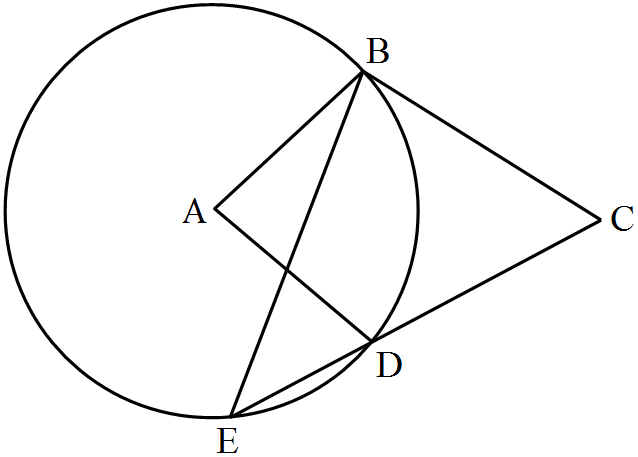
In the given figure, A is the centre of the circle. ABCD is a parallelogram and CDE is a straight line. Find $\angle\text{BCD}:\angle\text{ABE}.$
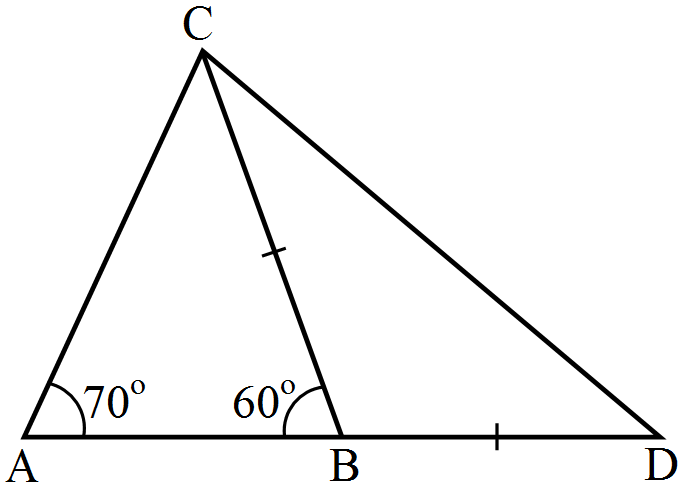
In $\triangle\text{ABC,}$ side AB is produced to D such that BD = BC. If $\angle\text{B}=60^{\circ},$ and $\angle\text{B}=60^{\circ},$ prove that:
  1. AD > CD and
  2. AD > AC.
In a $\triangle\text{ABC},$ the internal bisectors of $\angle\text{B}$ and $\angle\text{E}$ meet at P and the external bisectors of $\angle\text{B}$ and $\angle\text{C}$ meet at Q. Prove that $\angle\text{BPC}+\angle\text{BQC}=180^\circ.$
In the adjoining figure, □ABCD is a trapezium. AB || DC. Points M and N are midpoints of diagonals AC and DB respectively, then prove that MN || AB.

Image

Observe the table given below. Check and decide, whether the individuals have to pay income tax.

Image

ABC is a triangle in which D is the mid-point of BC. E and F are mid-points of DC and AE respectively. IF area of $\triangle\text{ABC}$ is $16cm^2,$ find the area of $\triangle\text{DEF}.$
Solve the following equations : $\quad \frac{(3 x-4)^3-(x+1)^3}{(3 x-4)^3+(x+1)^3}=\frac{61}{189}$
If $a(y+z)=b(z+x)=c(x+y)$ and out of $a, b, c$ no two of them are equal, then show that, $\frac{y-z}{a(b-c)}=\frac{z-x}{b(c-a)}=\frac{x-y}{c(a-b)}$.