Question
Construct ∆ABC, such that BC = 6 cm, ∠ABC = 100° and AC – AB = 2.5 cm.

Here, AC – AB = 2.5 cm
∴ AC > AB
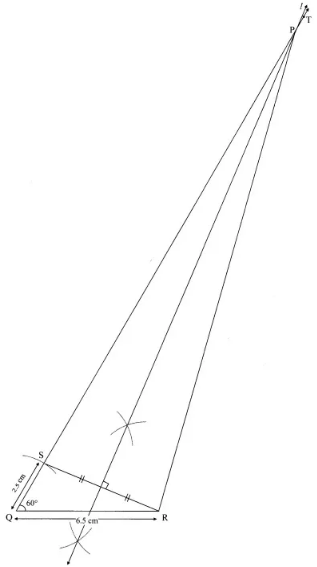
As shown in the rough figure draw seg BC = 6 cm
Draw a ray BT making an angle of 100° with BC.
Take a point D on opposite ray of BT, :
such that BD 2.5 cm.
Now, AD – AB = BD [A-B-D]
∴ AD – AB = 2.5cm …..(i)
Also, AC – AB = 2.5 cm …..(ii) [Given]
∴ AD – AB = AC – AB [From (i) and (ii)]
∴ AD = AC
∴ Point A is on the perpendicular bisector of seg DC
∴ Point A is the intersection of ray BT and the perpendicular bisector of seg DC
Steps of construction:
i. Draw seg BC of length 6 cm.
ii. Draw ray BT, such that ∠CBT = 100°.
iii. Take point D on opposite ray of BT such that l(BD) = 2.5 cm.
iv. Join the points D and C.
v. Draw the perpendicular bisector of seg DC intersecting ray BT. Name the point as A.
vi. Join the points A and C.
Hence, ∆ABC is the required triangle.
Generate a complete, print-ready paper with questions like this in minutes — across 16+ boards, with answer keys.
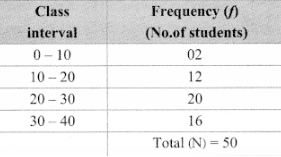
From the table, fill in the blanks in the following statements.
i. For class interval 10 – 20 the lower class limit is _____ and upper class limit is _____
ii. How many students obtained marks less than 10? 2
iii. How many students obtained marks less than 20? 2 + ____ = 14
iv. How many students obtained marks less than 30? ______ + _____ = 34
v. How many students obtained marks less than 40? ______ + ______ =50