Question
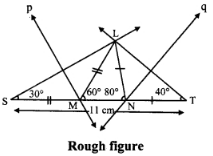
Construct ∆LMN, in which ∠M = 60°, ∠N = 80° and LM + MN + NL = 11 cm.
Answer


Image

i. As shown in the figure, take point S and T on line MN, such that
MS = LM and NT = LN …..(i)
MS + MN + NT = ST [S-M-N, M-N-T]
∴ LM + MN + LN = ST …..(ii)
Also,
LM + MN + LN = 11 cm ….(iii)
∴ ST = 11 cm [From (ii) and (iii)]

ii. In ∆LSM
LM = MS
∴ ∠MLS = ∠MSL = x° …..(iv) [isosceles triangle theorem]
In ∆LMS, ∠LMN is the exterior angle.
∴ ∠MLS + ∠MSL = ∠LMN [Remote interior angles theorem]
∴ x + x = 60° [From (iv)]
∴ 2x = 60°
∴ x = 30°
∴ ∠LSM = 30°
∴ ∠S = 30°
Similarly, ∠T = 40°

iii. Now, in ∆LST
∠S = 30°, ∠T = 40° and ST = 11 cm
Hence, ALST can be drawn.

iv. Since, LM = MS
∴ Point M lies on perpendicular bisector of seg LS.
Also LN = NT
∴ Point N lies on perpendicular bisector of seg LT.
∴ Points M and N can be located by drawing the perpendicular bisector of LS and LT respectively.
∴ ∆LMN can be drawn.

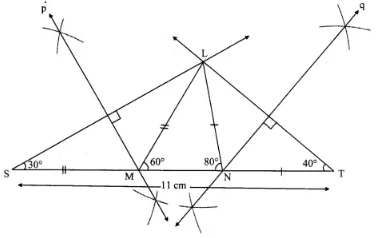
Steps of construction:
i. Draw seg ST of length 11 cm.
ii. From point S draw ray making angle of 30°.
iii. From point T draw ray making angle of 40°.
iv. Name the point of intersection of two rays as L.
v. Draw the perpendicular bisector of seg LS and seg LT intersecting seg ST in M and N respectively.
vi. Join LM and LN.
Hence, ∆LMN is the required triangle.

Image

Need a full question paper?

Generate a complete, print-ready paper with questions like this in minutes — across 16+ boards, with answer keys.

Start Generating Free

Similar questions

The distance between two places A and B on a road is 70 kilometres. A car starts from A and the other from B. If they travel in the same direction, they will meet in 7 hours. If they travel towards each other they will meet in 1 hour, then find their speeds.
The following table gives the quantity of goods (in crores of rupees)
Year
1950–51
1960–61
1965–66
1970–71
1980–81
1982–83
Quantity of goods (in crore tonnes)
9
16
20
20
22
26
Represent this information with the help of a bar graph.
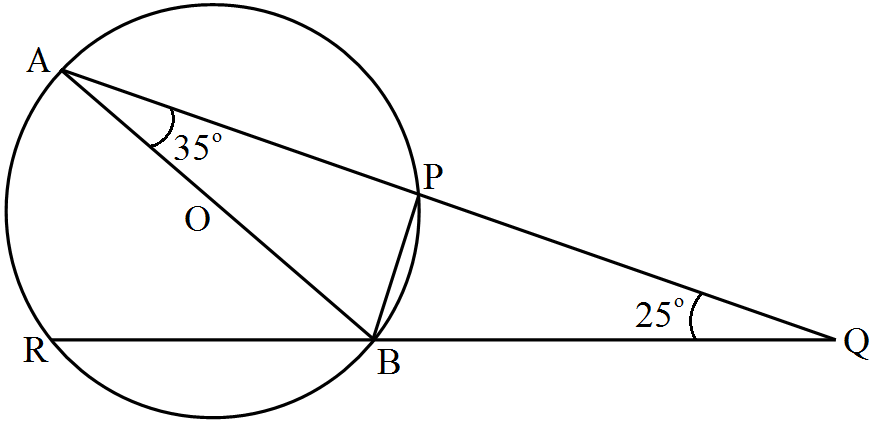
In the given figure, AB is a diameter of the circle such that $\angle\text{A}=35^\circ$ and $\angle\text{Q}=25^\circ,$ find $\angle\text{PBR.}$
ABC is a triangle in which D is the mid-point of BC. E and F are mid-points of DC and AE respectively. IF area of $\triangle\text{ABC}$ is $16cm^2,$ find the area of $\triangle\text{DEF}.$
The polynomial $p(x)=x^4-2 x^3+3 x^2-a x+b$ when divided by $(x-1)$ and $(x+1)$ leaves the remainders 5 and 19 respectively.
Find the values of $a$ and $b$. Hence, find the remainder when $p(x)$ is divided by $(x-2)$.
Prove that the line segments joining the middle points of the sides of a triangle divide it into four congruent triangles.
Each side of a rhombus is 10cm long and one of its diagonals measures 16cm. Find the length of the other diagonal and hence find the area of the rhombus.
The sum of a two digit number and the number obtained by interchanging its digits is 99. Find the number.
If O is a point within $\triangle\text{ABC,}$ show that:
  1. AB + AC > OB + OC
  2. AB + BC + CA > OA + OB + OC
  3. OA + OB + OC > $\frac{1}{2}$ (AB + BC + CA).
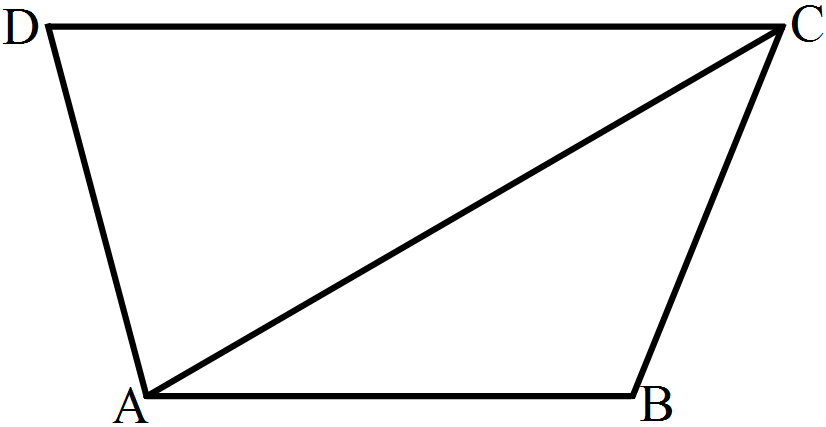
In the adjoining figure, ABCD is a quadrilateral and AC is one of its diagonals. Prove that:
(i) AB + BC + CD + DA > 2AC
(ii) AB + BC + CD > DA
(iii) AB + BC + CD + DA > AC + BD