Question
Construct, if possible, a quadrilateral $ABCD$ given $AB = 6\ cm, BC = 3.7\ cm, CD = 5.7\ cm, AD = 5.5\ cm$ and $BD = 6.1\ cm$. Give reasons for not being able to construct it, if you cannot.
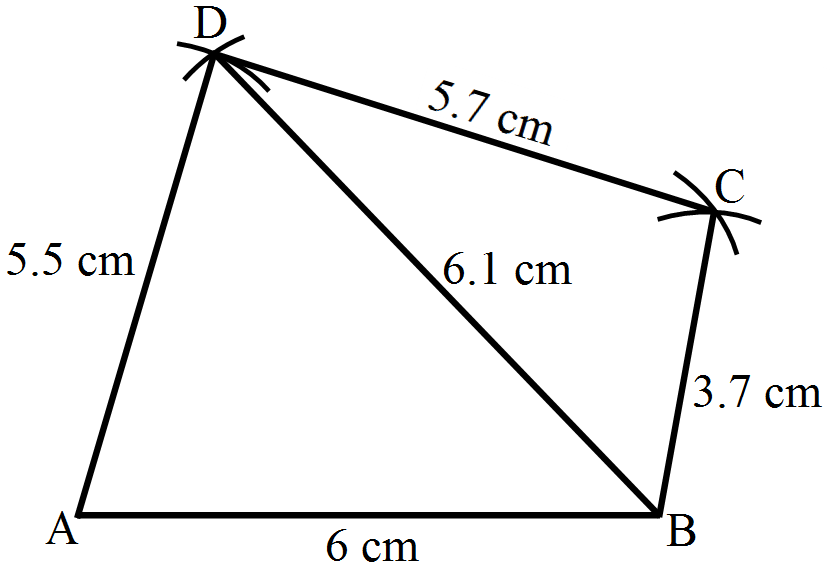
Answer


Steps of construction:
Step $I$: Draw $AB = 6\  cm$.
Step $II$: With $A$ as the centre and radius $5.5\ cm$, draw an arc.
Step $III$: With $B$ as the centre and radius $6.1\ cm$, draw an arc to intersect th arc drawn in Step $II$ at $D$.
Step $IV$: With $B$ as the centre and radius $3.7\ cm$, draw an arc on the side.
Step $V$: With $D$ as the centre and radius $5.7\ cm$, draw an arc to intersect the arc drawn in Step $IV$ at $C$.
Step $VI$: Join $BD, DA, BC$ and $CD$. The quadrilateral $ABCD$ so obtained is the required quadrilateral.

Need a full question paper?

Generate a complete, print-ready paper with questions like this in minutes — across 16+ boards, with answer keys.

Start Generating Free

Similar questions

It $x$ and $y$ vary inversely, fill in the following blanks:
$x$
$12$
$16$
$...$
$8$
$...$
$y$
$...$
$6$
$4$
$...$
$0.25$
Find the least number of six digits which is a perfect square.
Solve the following equation and verify your answer: $\frac{2\text{x}-3}{3\text{x}+2}=-\frac{2}{3}$
Arrange the following rational numbers in descending order: $\frac{-5}{6},\frac{-7}{12},\frac{-13}{18},\frac{23}{-24}$
If $a$ and $b$ vary inversely to each other, then find the values of $p, q, r ; x, y, z$ and $l, m, n.$
$a$
$6$
$8$
$q$
$50$
$b$
$18$
$p$
$39$
$r$
 
$a$
$2$
$y$
$6$
$10$
$b$
$x$
$12.5$
$15$
$z$
 
$a$
$l$
$9$
$n$
$6$
$b$
$5$
$m$
$25$
$10$
Construct a quadrilateral $PQRS$ in which $PQ = 4.2\ cm,$ $\angle\text{PQR}=60^\circ,\angle\text{QPS}=120^\circ,$ $QR = 5\ cm$ and $PS = 6\ cm.$
$A, B$ and $C$ can do a piece of work in $15, 12$ and $20$ days respectively. They started the work together, but $C$ left after $2$ days. In how many days will the remaining work be completed by $A$ and $B?$
The monthly wages of $30$ workers in a factory are given below:
$830, 835, 890, 810, 835, 836, 869, 845, 898, 890, 820, 860, 832, 833, 855, 845, 804, 808, 812, 840, 885, 835, 836, 878, 840, 868, 890, 806, 840, 890.$
Represent the data in the form of a frequency distribution with class size $10$.
Construct a quadrilateral $PQRS$ in which $PQ = 6\ cm, QR = 5.6\ cm, RS = 2.7\ cm,$ $\angle\text{Q}=45^\circ$ and $\angle\text{R}=90^\circ.$
Ranika wanted her friend Radhika's mobile number. But Radhika played a trick. She gave her the number as
$9 X Y Z P 1 Q 2 R 3$
and told her to decode it with the help of following equations:
(a) $16 X-35=7 X-8$
(b) $\frac{6 Y-7}{3 Y+9}=\frac{1}{3}$
(c) $\frac{4 Z-5}{8+6 z}=\frac{3}{20}$
(d) $P+\frac{3}{10} P=\frac{13}{10}$
(e) $4(Q+4)=5(Q+2)$
(f) $3(R+10)+200=236$