Question
Construct with ruler and compass, angle of measure $135^\circ .$
Answer

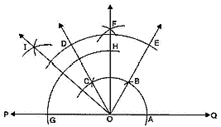
$i.\ $Draw any line $PQ$ and take a point $O$ on it.
$ii.\ $Place the pointer of the compasses at $O$ and draw an arc of convenient radius which cuts the line at $A.$
$iii.\ $Without disturbing the radius on the compasses, draw an arc with $A$ as centre which cuts the first arc at $B.$
$iv.\ $Again without disturbing the radius on the compasses and with $B$ as centre, draw an arc which cuts first arc at $C.$
$v.\ $Join $OB$ and $OC.$
$vi.\ $With $O$ as centre and using compasses, draw an arc that cuts both rays of $\angle COB.$ Label the points of intersection as $D$ and $E.$
$vii.\ $With $E$ as centre, draw $($in the interior of $\angle COB)$ an arc whose radius is more than half the length $ED.$
$viii.\ $With the same radius and with D as centre, draw another arc in the interior of $\angle COB.$ Let the two arcs intersect at $F.$ Join $\overline {OF}$. Then, $\overline {OF}$ is the bisector of $\angle COB,$ i.e. $\angle COF = \angle FOB.$ Now, $\angle FOQ = 90^\circ .$
$ix.\ $With $O$ as centre and using compasses, draw an arc that cuts both rays of $\angle POF.$ Label the points of intersection as $G$ and $H.$
$x.\ $With $H$ as centre draw $($in the interior of $\angle POF)$ an arc whose radius is more than half the length $HG.$
$xi.\ $With the same radius and with $G$ as centre, draw another arc in the interior of $\angle POF.$ Let the two arcs intersect at $I.$ Join $OI.$ Then, $\overline {OI}$ is the bisector of $\angle POF,$ i.e. $\angle GOI = \angle IOF.$ Now, $\angle IOQ = 135^\circ .$

Need a full question paper?

Generate a complete, print-ready paper with questions like this in minutes — across 16+ boards, with answer keys.

Start Generating Free

Similar questions

Draw a line segment of length $12.8\ cm.$ Using compasses, divide it into four equal parts. Verify by actual measurement.
Find the missing numbers:
(a) 5 glasses of juice shared equally among 4 friends is the same as __________ glasses of juice shared equally among 8 friends. So, $\frac{5}{4}=\frac{?}{8}$
(b) 4 kg of potatoes divided equally in 3 bags is the same as 12 kgs of potatoes divided equally in __________ bags. So, $\frac{4}{3}=\frac{12}{?}$.
(c) 7 rods divided among 5 children is the same as rods divided among children. So, $\frac{7}{5}=$ __________
If m is a whole number less than $5,$ complete the table and by inspection of the table, find the solution of the equation $2m - 5 = -1:$
$m$          
$2m - 5$          
The following table shows the interest paid by a company (in lakhs):
Year
$1995-96$
$1996-97$
$1997-98$
$1998-99$
$1999-2000$
Interest (in lakhs of rupees)
$20$
$25$
$15$
$18$
$30$
Draw the bar graph to represent the above information.
Draw an angle of $50^\circ $ with the help of protractor. Draw a ray bisecting this angle.
Write the fractions and pair up the equivalent fractions from each row.
Arrange the following decimal numbers in the ascending order: $0.52314, 0.52313, 0.53201, 0.52321$
Use a pair of compasses and construct the following angles: $150^\circ $
Find the greatest number that will divide $445, 572$ and $699$, leaving remainders $4, 5, 6$ respectively.
What part of a revolution have you turned through if you stand facing south and turn clockwise to face east?