Question
Construct with ruler and compasses, angles of measure: $30^\circ $
Answer


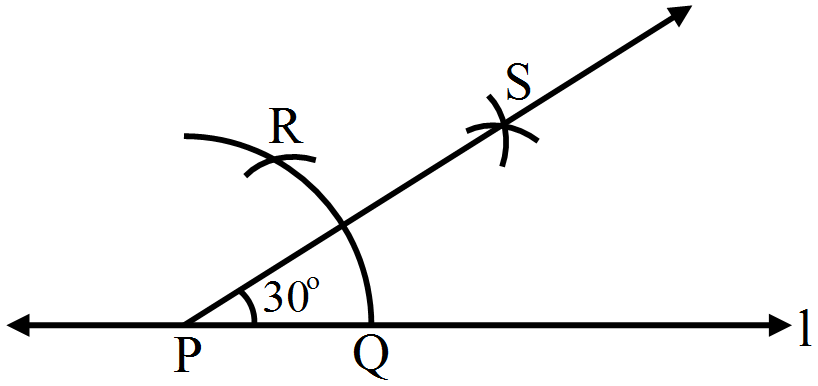
The below given steps will be followed to construct an angle of $30^\circ .$
$1.$Draw a line $l$ and mark a point $P$ on it. Now taking $P$ as centre and with convenient radius, draw an arc of a circle which intersects line $l$ at $Q.$
$2.$Taking $Q$ as centre and with the same radius as before, draw an arc intersecting the previously drawn arc at point $R.$
$3.$Now, taking $Q$ and $R$ as centre and with radius more than $\frac{1}{2}RQ,$ draw arcs to intersect each other at $S.$ Join $PS$ which is the required ray making $30^\circ $ with line $l.$

Need a full question paper?

Generate a complete, print-ready paper with questions like this in minutes — across 16+ boards, with answer keys.

Start Generating Free

Similar questions

The final marks in mathematics of 30 students are as follows:
536148607868551006790
75887737845860486256
44585264985970395060
(i) Arrange these marks in the ascending order. 30 to 39 one group, 40 to 49 second group, etc
(ii) What is the highest score?
(iii) What is the lowest score?
(iv) What is the range?
(v) If 40 is the pass mark how many have failed?
(vi) How many have scored 75 or more?
(vii) Which observations between 50 and 60 have not actually appeared?
(viii) How many have scored less than 50?
Following is the list of temperatures of five places in India on a particular day of the year.
Place Temperature  
Siachin $10^\circ C$ below $0^\circ C$ _________
Shimla $2^\circ C$ below $0^\circ C$ _________
Ahmedabad $30^\circ C$ above $0^\circ C$ _________
Delhi $20^\circ C$ above $0^\circ C$ _________
Srinagar $5^\circ C$ below $0^\circ C$ _________
Following is the number line representing the temperature in degree Celsius. Plot the name of the city against its temperature.
Find the value of $– 8 – (–10)$ using number line
How many little squares are there in each shape of the sequence of stacked squares? Which number sequence does this give? Can you explain, why?
Identify whether each statement is true or false. Explain.
(a) There is no prime number whose units digit is 4.
(b) A product of primes can also be prime.
(c) Prime numbers do not have any factors.
(d) All even numbers are composite numbers.
(e) 2 is a prime and so is the next number, 3. For every other prime, the next number is composite.
Find the sum: $(– 7) + (– 9) + 4 + 16$
Draw an angle of measure $45^\circ $ and bisect it.
Mark the following points on a sheet of paper. Tell how many line segments can be obtained in each case:
(i) Two points $A, B$.
(ii) Three non-collinear points $A, B, C$.
(iii) Four points such that no three of them belong to the same line.
(iv) Any five points so that no three of them are collinear.
[Hint: Put $n=2,3,4,5$ in the following formula and check the truth of the statement in each case: If there are $n$ points in a plane such that no three of them are collinear, then the number of line segments obtained by joining these points is equal to $\frac{n(n-1)}{2}$ ]
Find the $HCF$ of the numbers in the following using the division method: $754, 1508, 1972$
Write the natural numbers from $102$ to $113.$ What fraction of them are prime numbers $?$
