MCQ
Conversion of $I$ to $II$
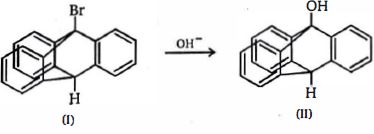
- Atakes place by $S_{N^1}$
- Btakes place by $S_{N^2}$
- Ctakes place both by $S_{N^1}$ and $S_{N^2}$
- ✓does not take place
The bromine atom is found to be virtually inert to nucleophilies. Despite the formal resemblance in the environment of the bromine atom in to that in, they are found to differ in their rate of reaction under parallel conditions by a factor of $\approx 10^{-23} : 1!$ This is because stabilisation of the carbocation in $(I)$ can occur by delocalisation of its charge through the $\pi$ -orbital systems of the three benzene rings; whereas the extremely rigid structure of $(II)$ will hold the cation's empty orbital (from loss of $Br^{\ominus}$ ) but at right angles to these $\pi$-orbital systems, thus preventing such delocalisation.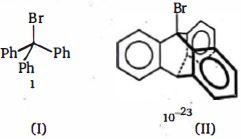
Generate a complete, print-ready paper with questions like this in minutes — across 16+ boards, with answer keys.
In the above first order reaction the initial concentration of $\mathrm{N}_{2} \mathrm{O}_{5}$ is $2.40 \times 10^{-2}\, \mathrm{~mol} \,\mathrm{~L}^{-1}$ at $318 \,K.$ The concentration of $\mathrm{N}_{2} \mathrm{O}_{5}$ after $1\, hour$ was $1.60 \times 10^{-2}\, \mathrm{~mol} \,\mathrm{~L}^{-1}$, The rate constant of the reaction at $318\, \mathrm{~K}$ is $.....\,\times 10^{-3} \mathrm{~min}^{-1}$. (Nearest integer)
[Given: $\log 3=0.477, \log 5=0.699$ ]